



























Walking York's city walls: the route, how long it takes, and what is free
How to walk the city walls of York: the full circuit gate by gate, the best short section, when the walls are closed, and which sights nearby are free and which need a ticket.

In 1800 the corporation of York asked Parliament for leave to pull down the city walls. They had been useless in war for a century and a half, they cost money to patch, and the gates were so narrow that coaches jammed in them. The plan came to nothing, but for the next thirty years the corporation took pieces down anyway: three of the four barbicans, several of the smaller gates, stretches of the wall itself.
What stopped it was a public campaign, one of the first of its kind in England. Its loudest voice was the painter William Etty, born in York, who wrote letter after letter in defence of the gates. By the middle of the century the city was paying to repair what it had tried to remove. The result is the longest circuit of medieval town walls in England, and one of the few great sights in the country that asks no ticket. The questions are how to walk it, and how much of it.
The walls in numbers
The circuit is about 3.4 kilometres, a little over two miles. Most of the stonework is of the thirteenth and fourteenth centuries, raised on earth banks older than the Norman conquest, and in one corner on the wall of the Roman fortress. There are four main gates, which in York are called bars, while the streets are called gates: Micklegate Bar, Bootham Bar, Monk Bar and Walmgate Bar.
A full round takes about two hours at an easy pace. The path is on top of the wall, narrow in places, with a parapet on the outer side. On the inner side there is a railing only in places.

The walkway on top of the walls, with the grass rampart falling away beside it. Photo: Tim Green, via Wikimedia Commons, CC BY 2.0.
The circuit, gate by gate
If you arrive by train, the wall is facing you as you leave the station. Climb the steps there and go clockwise.
From the station to Bootham Bar
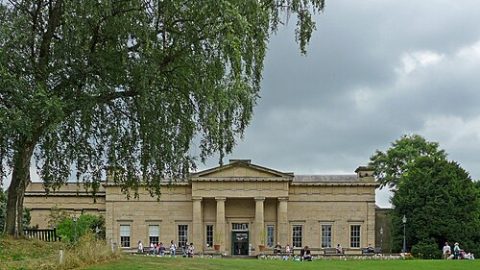
The wall runs down to the river Ouse with the Minster ahead of you the whole way, the view on every postcard. It stops at Lendal Bridge. Cross the bridge and go through the Museum Gardens, where the Multangular Tower shows the corner of the Roman fortress: small neat stones with a band of red tile below, larger medieval blocks above.
Bootham Bar to Monk Bar
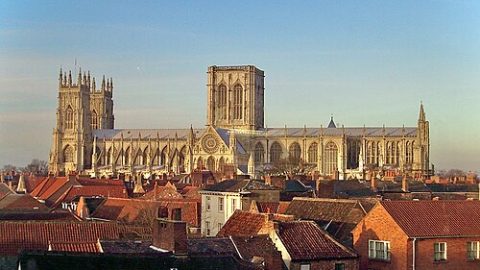
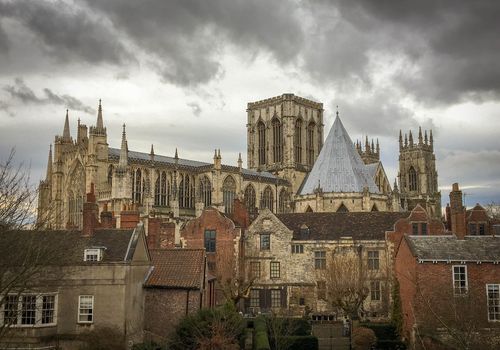
The best quarter of an hour of the walk. Bootham Bar stands where the north-west gate of the Roman fortress stood. From it the wall turns behind the Minster, above walled gardens that you cannot see from any street, with the whole length of the cathedral beside you. It comes down at Monk Bar, the tallest of the four, which still has its portcullis.
Monk Bar to Walmgate Bar
A quieter stretch, ending at a real gap. Here the Normans dammed the river Foss and made a wide marshy pool that defended the town by itself, so no wall was ever built. Follow the road beside the Foss to the Red Tower, a small brick tower of 1490, where the wall begins again and leads to Walmgate Bar. This is the only gate in England that kept its barbican, the walled passage in front that forced attackers into a trap. The scars on it date from the siege of 1644.

Walmgate Bar, the only gate that still has its barbican. Photo: Chabe01, via Wikimedia Commons, CC BY-SA 4.0.
Walmgate Bar to Micklegate Bar
The wall passes Fishergate, then breaks again at the castle. Walk past Clifford's Tower, cross the Ouse by Skeldergate Bridge and climb back up. The last section leads to Micklegate Bar, the gate by which kings entered the city and above which the heads of traitors were displayed. In 1460 one of them was Richard, Duke of York, wearing a paper crown. A few minutes more bring you back to the station.

Micklegate Bar, the gate by which kings entered York. Photo: Tim Green, via Wikimedia Commons, CC BY 2.0.
If you have half an hour
Walk from Bootham Bar to Monk Bar, then come back at street level through the Minster's precinct. If you have ten minutes before a train, climb the steps opposite the station and walk towards the river and back. In March and April the banks below that stretch are yellow with daffodils.
Rules, and when the walls are closed
- The walls are free, and open from about eight in the morning until dusk. The gates at the foot of the steps are locked at night.
- They are closed when there is ice or snow, and sometimes in high winds. The stone is slippery when wet.
- Every access is by steps, some of them steep and narrow. There is no route for wheelchairs or pushchairs.
- Keep hold of small children: the inner edge is open in many places.
- Dogs are not allowed on the walls, apart from assistance dogs.
- In the gaps, small brass markers set in the pavement show the way to the next section.
What costs money in York, and what does not
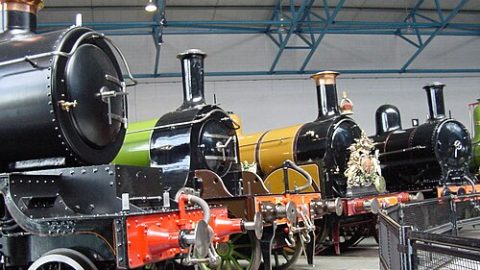
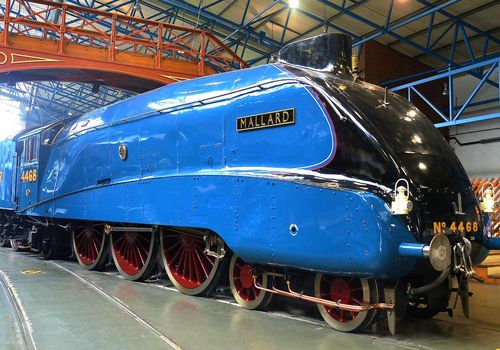
- Free: the walls, the Museum Gardens with the ruins of St Mary's Abbey, the Shambles, the street of overhanging butchers' houses, and the National Railway Museum behind the station, which holds Mallard, the locomotive that set the world speed record for steam in 1938.
- With a ticket: York Minster, which charges visitors outside service times, with the climb of its central tower sold separately. Also Clifford's Tower, the keep of the castle, the Jorvik Viking Centre, the York Castle Museum and the York Dungeon.

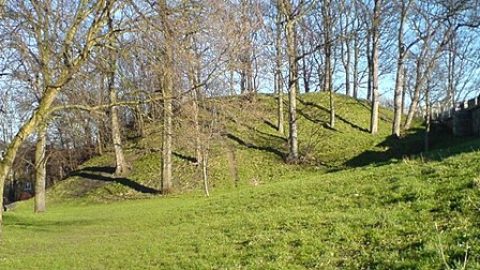
Clifford's Tower, the keep of York Castle, on its mound. Photo: Chabe01, via Wikimedia Commons, CC BY-SA 4.0.
Reading the partner's listings
Nobody sells a ticket to the walls, because there is none. What our partner has in York is this:
- National Railway Museum timed entry and audio tour with a city walk. The museum is free. The listing gives you a booked free slot, a narrated route through its halls in the partner's app, and an audio walk through the city that takes in the walls.
- An audio tour of York through its history. A walk of about two hours past the Minster, the Shambles and Clifford's Tower. No entry tickets are part of it.
- A ghost stories audio tour. The same streets after dark, with the legends. No tickets either.
- York Dungeon entry ticket. A show with actors about the grim side of the city's past. It is an attraction of its own and has nothing to do with the walls.
These are the tickets and audio tours our partner sells in York, with today's prices:
-
 on WeGoTrip
Skip The Line Tickets York: National Railway Museum Timed Entry & Audio Tour with a City Walk
Book on WeGoTripfrom€5
-
 on WeGoTrip
Museum & Attraction Tickets York Dungeon: Entry Ticket
Book on WeGoTripfrom€34.24
-
 on WeGoTrip
History & Heritage York: An Audio Tour Through Time and Heritage
Book on WeGoTripfrom€10
-
 on WeGoTrip
History & Heritage York: Ghost Tales & Cocoa Trails Audio Tour
Book on WeGoTripfrom€11
Sold and delivered by WeGoTrip. You book on their site at their price; Viaqui may earn a commission, at no extra cost to you.
From here
From Bootham Bar it is two minutes to the west door of York Minster. The National Railway Museum is behind the station, and the York Castle Museum stands beside Clifford's Tower, where the circuit breaks. York is about two hours from London by train and two and a half from Edinburgh, so it works as a stop between the two. Hours for the walls are on our page for the York city walls. See what else there is in York, or open the attractions map of the United Kingdom.
Cover photo: Oscar Taylor, via Wikimedia Commons, CC BY-SA 2.0.
Frequently asked questions
How long does it take to walk York city walls?
About two hours for the full circuit of roughly 3.4 kilometres, including the three places where you come down to street level. The best short section, from Bootham Bar to Monk Bar, takes a quarter of an hour.
Are the York city walls free?
Yes. There is no ticket and no booking. The walls are open from about eight in the morning until dusk and are closed in ice, snow and sometimes high winds.
Where is the best place to start the York walls walk?
If you come by train, at the steps opposite the station, going clockwise towards the river with the Minster ahead. Otherwise start at Bootham Bar, beside the Minster.
Can you walk all the way round York on the walls?
Almost. The wall is missing in three places: at Lendal Bridge, along the river Foss, where a marshy pool once defended the town, and at the castle. Brass markers in the pavement show the way between the sections.
Are the York city walls suitable for pushchairs or wheelchairs?
No. Every access is by steps, the path is narrow, and the inner edge has no railing in many places.