






























Pitti Palace and Boboli Gardens: which ticket you need, and how to split half a day
The Pitti Palace and the Boboli Gardens in Florence are sold separately. What the palace ticket opens, what the garden ticket opens, when a combined ticket makes sense, and how to fit both into half a day.

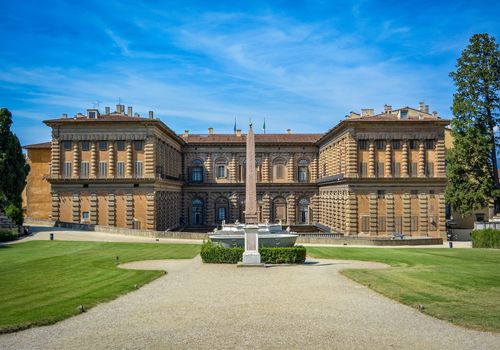
Luca Pitti was a banker, and for a time the most powerful ally the Medici had. About 1458 he began a palace on the far side of the Arno, on rising ground, meant to be larger than anything his friends owned. The story Florentines told later was that he wanted windows as big as the Medici's front door. He lost his standing, ran short of money, and died in 1472 with the building unfinished.
In 1549 his heirs sold it. The buyer was Eleonora of Toledo, wife of Duke Cosimo I de' Medici, who wanted air and a garden for a large family. So the palace built to outdo the Medici became their home, and then the home of every ruler of Tuscany after them. They enlarged it for three centuries and filled it with pictures, and behind it they laid out a garden up the hill. Today these are two separate visits, sold with two separate tickets, and that is where most confusion begins.
Two tickets, not one
There is one ticket office, on the right-hand side of the front on Piazza Pitti, and it sells different things:
- The palace ticket opens the museums inside the building: the Palatine Gallery, which is the reason to come, the Gallery of Modern Art on the top floor, the Treasury of the Grand Dukes on the ground floor, and the Museum of Costume and Fashion. It does not open the gardens.
- The Boboli ticket opens the gardens behind the palace, the small Porcelain Museum at the top of them, and the Bardini Garden, a second hillside garden ten minutes' walk to the east. It does not open the palace.
- A combined ticket covers both, and there is a wider one that adds the Uffizi and runs over several days in a row. Check how many days, and whether each place can be entered once only.
The palace is closed on Mondays. The gardens keep a calendar of their own, with closing days that do not match the palace, and they shut earlier in winter. On the first Sunday of the month both are free and both are crowded.
The palace: where to spend your time
Go to the Palatine Gallery first, on the main floor. It is unlike the Uffizi. The pictures are not arranged by date or school. They hang as the grand dukes hung them, frame against frame up to the cornice, in rooms with painted ceilings and silk on the walls.
- The planet rooms. Five rooms in a row, named after Venus, Apollo, Mars, Jupiter and Saturn, with ceilings painted by Pietro da Cortona in the 1640s. The best pictures are here.
- Raphael. The round Madonna of the Chair, in the Saturn room, and the portrait known as the Veiled Woman.
- Titian. The portrait of a young man with grey eyes, called the Young Englishman, and the woman in a blue dress known as La Bella.
- Rubens. The Consequences of War, painted in 1638, in which Mars pulls away from Venus while Europe throws up her arms.
- Caravaggio. A small, dark Sleeping Cupid, painted in Malta.
- Canova. The marble Venus in the middle of the Venus room.
Allow an hour and a half. The other museums in the building are worth the stairs only if you have a particular interest in them.

One of the state rooms of the palace: stucco, columns and chandeliers. Photo: Dimitris Kamaras, via Wikimedia Commons, CC BY 2.0.
The gardens: a walk uphill
The Boboli Gardens were begun in 1549 for Eleonora and became the model for the court gardens of Europe. They are large and steep. The paths are gravel, there is little shade on the main axis, and you gain a good deal of height. Wear proper shoes and carry water.
- The amphitheatre. Directly behind the palace, in the hollow left by the quarry that supplied its stone. An Egyptian obelisk stands in the middle, brought from the Villa Medici in Rome in 1790.
- The climb. Straight up past the Fountain of Neptune to the statue of Abundance. Turn round here: the palace is below you, and the cathedral dome beyond it.
- The Knight's Garden. At the very top, a small walled garden with the Porcelain Museum and a view over olive groves to the south.
- The cypress avenue and the Isolotto. A long straight avenue runs down the western slope to an oval pool with an island in it.
- The Great Grotto. Near the exit, built by Bernardo Buontalenti between 1583 and 1593. Michelangelo's unfinished Prisoners stood in its corners until 1909, when they went to the Accademia. The figures there now are copies.
The full loop takes an hour and a half to two hours.

The amphitheatre behind the palace, cut into the hollow of an old quarry. Photo: Rufus46, via Wikimedia Commons, CC BY-SA 3.0.

The reward for the climb: the cathedral dome over the roofs of the city. Photo: Txllxt TxllxT, via Wikimedia Commons, CC BY-SA 4.0.

The Isolotto, the pool at the far end of the gardens. Photo: Armin Kleiner, via Wikimedia Commons, CC BY-SA 4.0.
Half a day, in the right order
In the warm months, do the gardens first, as soon as they open, and go into the palace when the sun is high. In winter, reverse it: the gardens close early, so see them before the light goes, but not at the very end of the day. Either way, allow three and a half to four hours for both, and take a break between them. If you have two hours only, choose one. On a hot or wet day choose the Palatine Gallery. On a clear spring morning choose the gardens.
Reading the partner's listings
- A Pitti Palace ticket with a Palatine Gallery audio tour is the palace ticket, with all the museums in the building, and commentary for the main gallery on your own phone. The gardens are not part of it.
- A ticket for the Pitti Palace, the Boboli and the Bardini Gardens with a sightseeing audio tour opens all three. Read the exclusions: the audio is a walk through the city and does not cover the inside of the palace.
- A highlights tour with a Boboli Gardens ticket is the garden ticket with a city audio walk. The voucher is swapped for a ticket at the palace ticket office. The palace is not included.
- A combined skip the line ticket with the Uffizi covers the Uffizi, the palace and the gardens. The listing says little, so check the days of validity before you book.
- The Palatine Gallery highlights audio tour is commentary only, with no entry.
These are the Pitti Palace and Boboli Gardens tickets and audio tours our partner sells, with today's prices:
-
 on WeGoTrip
Attraction Tickets Florence: Pitti Palace, Boboli & Bardini Gardens Ticket & Sightseeing Audio Tour
Book on WeGoTripfrom2,629 den
-
 on WeGoTrip
Museum & Attraction Tickets Uffizi Gallery, Pitti Palace & Boboli Gardens: Skip The Line Ticket
Book on WeGoTripfrom3,286 den
-
 on WeGoTrip
Attraction Tickets Florence Highlights Tour with Boboli Gardens Ticket
Book on WeGoTripfrom1,461 den
-
 on WeGoTrip
Skip The Line Tickets Florence: Pitti Palace Ticket & Palatine Gallery Audio Tour
Book on WeGoTripfrom2,029 den
-
 on WeGoTrip
Walking Tours Florence: Pitti Palace's Palatine Gallery Highlights Audio Tour
Book on WeGoTripfrom553 den
Sold and delivered by WeGoTrip. You book on their site at their price; Viaqui may earn a commission, at no extra cost to you.
Hours change with the season: see our pages for the Pitti Palace and the Boboli Gardens.
From here
You are on the quieter bank of the river. The church of Santo Spirito, the last that Brunelleschi designed, is five minutes west, on a square with a morning market. The Ponte Vecchio is five minutes north, with the Vasari Corridor running over it from the palace towards the Uffizi. See what else there is in Florence, or open the trip planner for Italy.
Cover photo: Suicasmo, via Wikimedia Commons, CC BY-SA 4.0.
Frequently asked questions
Does the Pitti Palace ticket include the Boboli Gardens?
No. The palace ticket opens the museums inside the building. The gardens have their own ticket, which also covers the Bardini Garden. A combined ticket covers both.
How long do you need for the Pitti Palace and the Boboli Gardens?
About an hour and a half for the Palatine Gallery and an hour and a half to two hours for the gardens. With a break, allow half a day for both.
What should you see in the Palatine Gallery?
The five planet rooms with ceilings by Pietro da Cortona, Raphael's Madonna of the Chair and Veiled Woman, Titian's portraits, Rubens's Consequences of War and Caravaggio's Sleeping Cupid.
Are the Boboli Gardens worth it?
Yes, in good weather and if you do not mind walking uphill. They are large and steep, with views over Florence from the top. In heat or rain the palace is the better choice.
Which day is the Pitti Palace closed?
The palace is closed on Mondays. The gardens have closing days of their own, so check both before you plan the visit.