





The Picasso Museum in Barcelona: what you will see, what you will not, and which ticket to book
The Picasso Museum in Barcelona shows how Picasso became Picasso: his teenage paintings, the Blue Period and the Las Meninas series. What is there, what is elsewhere, how timed tickets and free hours work, and what each listing includes.

When the museum opened on Carrer de Montcada in March 1963, the name of Picasso was not the one put forward. Spain was ruled by Franco, and Picasso, who had painted Guernica and sworn not to return while the dictator lived, was not a man the regime wished to honour. So the city presented the new museum as the collection of Jaume Sabartés, a Barcelona friend of his youth who had become his secretary, and who gave the hundreds of works he owned to start it.
Picasso never saw it. He was eighty-one, lived in France, and had last been in Barcelona in 1934. He sent pictures instead: when Sabartés died in 1968 he gave a whole series in his memory, and in 1970 he gave everything his family had kept in the city since he was a boy. That history explains what hangs here, and it is the first thing to know before you buy a ticket.
What you will see
The collection, more than four thousand works, is strongest at the beginning. It follows a child who could draw like an adult until the moment he stopped wanting to. The rooms run in order of time.
- The teenager. Picasso came to Barcelona in 1895, at thirteen, when his father took a post at the city's art school. First Communion, painted at fourteen, and Science and Charity, a large hospital scene painted at fifteen, are exactly what a jury of the day wanted. He could have had that career.
- The young man about town. Portraits of friends, small street and café scenes, and the first trips to Paris, from the years around his first exhibition in 1900.
- The Blue Period. A handful of pictures from 1901 to 1904, the years in which he moved between Barcelona and Paris before leaving for good.
- The return in 1917. He came back for some months with the Russian Ballet. The Harlequin from that stay was his gift to the city, and the first Picasso to enter a public collection in Spain.
- Las Meninas. In 1957, in the south of France, he shut himself away with a single painting by Velázquez and produced fifty-eight canvases from it in a few months. The whole series is here, in its own rooms, and it is the one part of the museum that shows the Picasso everyone knows.
- Prints and ceramics. Rooms of engravings, and pottery given by his widow Jacqueline.

A courtyard with its open staircase to the main floor, the pattern of every palace on the street. Photo: haitham alfalah, via Wikimedia Commons, CC BY-SA 3.0.
What you will not see
Guernica is in Madrid, at the Reina Sofía. Les Demoiselles d'Avignon, named after a street of brothels a few minutes from here, Carrer d'Avinyó, is in New York. The great cubist pictures are in Paris and elsewhere. If you come expecting them, you will be puzzled by rooms of careful portraits and seascapes.
So is it worth it? Yes, if you are curious about how a painter is made, or if Las Meninas alone sounds like a reason. It is less rewarding as a first meeting with Picasso, and children who do not already know his later work tend to lose interest by the third room.
The building is half of it
The museum fills five medieval palaces in a row. Carrer de Montcada was the street of Barcelona's richest merchants from the thirteenth century to the fifteenth, when the city traded across the whole Mediterranean. Each house follows the same plan: a plain front, a gate wide enough for a cart, a courtyard, and an open stone staircase to the main floor. You pass through several of these courtyards during the visit, and you may look into the first ones without a ticket.

Carrer de Montcada, the medieval merchants' street where the museum stands. Photo: Andrei Dan Suciu, via Wikimedia Commons, CC BY 3.0.

The street front of the Aguilar palace, the first of the five the museum took over. Photo: Pere López, via Wikimedia Commons, CC BY-SA 3.0.
How the tickets work
- Entry is timed. You book a slot. In spring and summer, and at weekends, the slots of the day are often gone by late morning.
- Collection, or collection and exhibition. The standard ticket covers the permanent collection. Temporary exhibitions are sold with it as a fuller ticket, or separately.
- Free hours exist, and must be booked. The museum has long opened without charge late on Thursday afternoons and on the first Sunday of the month. You still need a ticket for a slot, released online a few days before, and they go quickly.
- Monday is the closing day.
Allow an hour and a half. Large bags go into lockers. The streets around are narrow and busy, so keep your phone and wallet out of back pockets.
Reading the partner's listings
- An entry ticket is entry to the museum and nothing else. The listing does not say whether temporary exhibitions are covered, so read the booking page.
- A ticket with an audio tour and a walk through El Born includes entry, commentary for the museum in the partner's app, and an audio walk through the quarter outside.
- A ticket with an audio tour and a city walk is close to the first: entry, a route through the rooms, and a walk. The commentary covers the permanent collection, not the temporary exhibition.
- The listings called only "audio tour", of the museum, or of the museum and El Born, do not include entry. You book your slot yourself.
These are the Picasso Museum tickets and audio tours our partner sells, with today's prices:
-
 on WeGoTrip
Art & Museums Barcelona: Picasso Museum Ticket & Audio Tour with El Born Walk
Book on WeGoTripfrom€23
-
 on WeGoTrip
Walking Tours Barcelona: Picasso Museum Ticket & Audio Tour with a City Walk
Book on WeGoTripfrom€21
-
 on WeGoTrip
Barcelona: Picasso Museum Entry Ticket
Book on WeGoTripfrom€17.50
-
 on WeGoTrip
Literary, Art & Music Tours Barcelona: Picasso Museum Audio Tour
Book on WeGoTripfrom€7
-
 on WeGoTrip
Walking Tours Barcelona: Picasso Museum & El Born Audio Tour
Book on WeGoTripfrom€14
Sold and delivered by WeGoTrip. You book on their site at their price; Viaqui may earn a commission, at no extra cost to you.
Current hours are on our page for the Picasso Museum.
From here
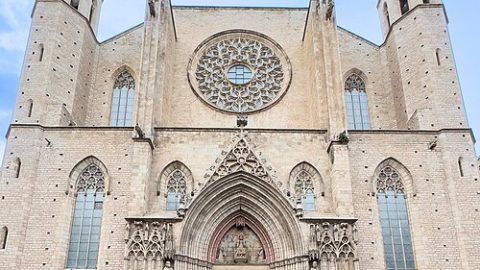
At the bottom of the street stands Santa Maria del Mar, built between 1329 and 1383 by the people of the quarter, the purest Gothic church in the city. A few minutes east, the old Born market shelters the excavated streets of the district pulled down after the siege of 1714, and the ground floor is free to walk through. Els Quatre Gats, the café where Picasso held his first exhibition, is ten minutes away, near the cathedral. For the rest of Barcelona, open the trip planner for Spain.

Santa Maria del Mar, three minutes from the museum. Photo: Kent Wang, via Wikimedia Commons, CC BY-SA 4.0.
Cover photo: Enric, via Wikimedia Commons, CC BY-SA 4.0.
Frequently asked questions
Is the Picasso Museum in Barcelona worth it?
Yes, if you want to see how Picasso developed: his teenage paintings, the Blue Period and the complete Las Meninas series. It holds few of his famous cubist works, so it is less suited as a first introduction.
Is Guernica in the Picasso Museum in Barcelona?
No. Guernica is in Madrid, at the Reina Sofía museum. The Barcelona museum's largest late work is the Las Meninas series of 1957.
When is the Picasso Museum in Barcelona free?
It has long been free late on Thursday afternoons and on the first Sunday of the month. Free tickets for a time slot must still be reserved online and run out fast.
How long does the Picasso Museum in Barcelona take?
About an hour and a half for the permanent collection. Add half an hour if you also visit a temporary exhibition.
Do you need to book the Picasso Museum in advance?
It is wise. Entry is by time slot, and in spring, summer and at weekends the slots for the same day are often sold out by late morning.