





Mozart's Salzburg on foot: a route through the old town, and what is free along it
A walking route through Salzburg in Mozart's footsteps, from the house where he was born to the Mirabell gardens, with what is free on the way, what needs a ticket, and what the partner's audio walks include.

For half a century after his death, Salzburg did very little about Mozart. He had left the town in 1781 after a quarrel with its ruler, the prince-archbishop, and had died in Vienna ten years later. When a committee at last collected money for a statue, the workmen digging its foundation in 1841 struck a Roman mosaic floor, and the unveiling had to wait a year.
The bronze figure was finally shown on 4 September 1842, in the square that now bears his name. His two sons were in the crowd. His widow Constanze, who had lived in a house on that same square, had died six months earlier. Today the whole old town trades on him, and the visitor has the opposite problem: sorting the places where Mozart really lived and worked from the chocolate, and knowing which of them cost nothing to see.
How the old town is laid out
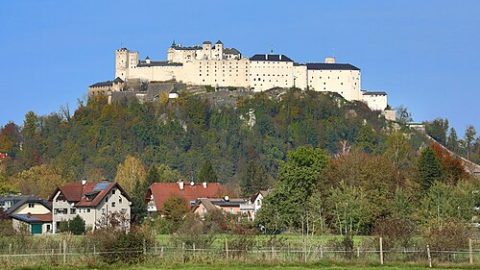
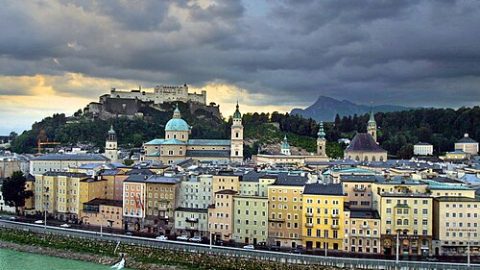
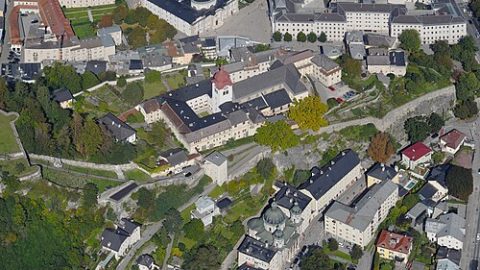
Salzburg's old town is a narrow strip between the river Salzach and a wall of rock, the Mönchsberg, with the fortress on a hill at one end. Almost all of it is closed to traffic, and you can cross it in fifteen minutes. A second, smaller old quarter lies across the river, with the Mirabell gardens. The route below takes two to three hours without going inside anything, and half a day with one museum.
The route, stop by stop
1. Getreidegasse 9, the birthplace
Wolfgang Amadeus Mozart was born on 27 January 1756 on the third floor of the tall yellow house at number 9, where his parents rented a flat for twenty-six years. It has been a museum since 1880 and needs a ticket: inside are the family rooms, portraits, letters and the violin he played as a child. The street itself, with its wrought-iron guild signs and the passages that run through the houses to the next street, is free.

Getreidegasse 9. The Mozarts rented the third floor. Photo: Jakub Hałun, via Wikimedia Commons, CC BY 4.0.
2. Alter Markt
The old market square has two institutions. Café Tomaselli is the oldest coffee house in the town. Opposite, the confectioner Fürst still makes by hand the Mozartkugel that Paul Fürst invented in 1890, wrapped in silver and blue. The red and gold ones sold everywhere else are later copies.
3. Residenzplatz and Mozartplatz
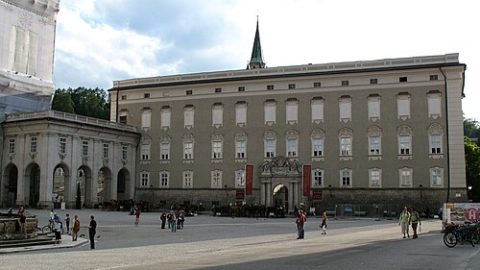
The largest square, with its baroque fountain, lies between the old and the new palace of the archbishops. The bells in the tower of the new palace play a tune three times a day, at seven, eleven and six. The statue of 1842 is on the smaller square next door. All of this is free.

Residenzplatz: the fountain, and on the right the tower whose bells play three times a day. Photo: DimiTalen, via Wikimedia Commons, CC0.
4. The cathedral
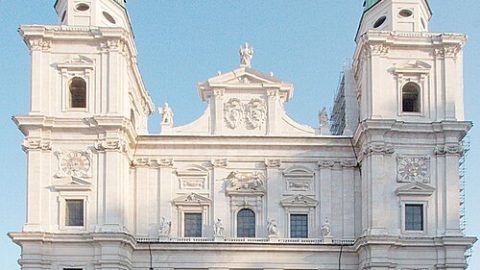
Mozart was baptised here the day after he was born, at the bronze font that still stands to the left of the entrance, and from 1779 he was the cathedral's organist. Outside the hours of services, visitors are now asked for an entry contribution.
5. St Peter's: the church, the cemetery, the catacombs
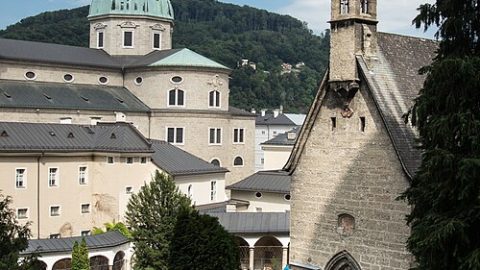
In the abbey church of St Peter, on 26 October 1783, Mozart conducted the first performance of his Mass in C minor, with Constanze singing one of the soprano parts. The church is free. So is the cemetery behind it, the oldest in the town, where his sister Nannerl is buried. The small chambers cut into the rock face above the graves, known as the catacombs, charge a small fee.

St Peter's cemetery, with the catacombs cut into the rock above the arcades. Photo: Isiwal, via Wikimedia Commons, CC BY-SA 4.0.
6. Across the river: the Mozart Residence
Cross by the footbridge. In 1773 the family moved to a larger flat in the Dancing Master's House on what is now Makartplatz, and Mozart lived there until he left for Vienna. Half the house was destroyed by a bomb in 1944 and rebuilt in the 1990s. It is the second Mozart museum, with its own ticket and a combined one with the birthplace.
7. The Mirabell gardens
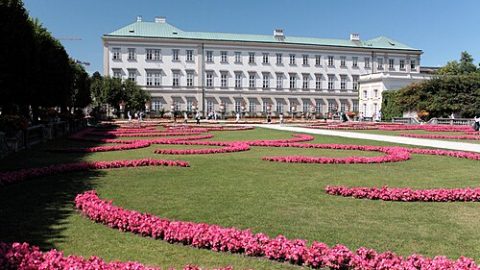
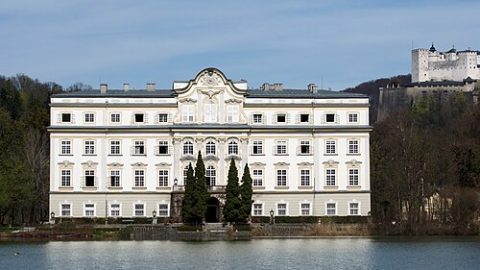
The gardens of the palace an archbishop built in 1606 are free, and the view from the steps at their northern end runs straight across the flower beds to the fortress. The young Mozarts played for the court in the palace's Marble Hall, which is now the town's wedding room.

The Mirabell gardens, with the fortress at the end of the view. Photo: Isiwal, via Wikimedia Commons, CC BY-SA 4.0.
Free, and not free
- Free: Getreidegasse and its passages, the squares and the bells, St Peter's church and cemetery, the Mirabell gardens, the walk up to the fortress walls.
- Ticket: the two Mozart houses, the cathedral outside services, the catacombs, the fortress and its funicular.
- One ticket for several: the DomQuartier is a single circuit through the archbishops' state rooms, where the boy Mozart performed, their picture gallery, the gallery above the cathedral's nave and the museum of St Peter's.
If you pay for only one Mozart house, choose the birthplace for the feeling of the rooms, the Residence for space and fewer people.
Reading the partner's listings
- The audio walks through the old town, the baroque churches and the Mirabell quarter are commentary in the partner's app, with a map. None of them includes entry anywhere. One states plainly that the ticket to Mozart's birthplace is extra.
- The walk "from High Baroque to the Catacombs" takes you into three churches, and warns that they may be shut early in the morning and in the evening.
- The DomQuartier entry ticket is the one listing with entry. It has no audio from the partner, and its page gives few details.
- The partner also lists day trips from Salzburg into Bavaria. They are not about the town.
These are the audio walks and tickets our partner sells in Salzburg, with today's prices:
-
 on WeGoTrip
History & Heritage Salzburg Old Town: a Historic Walk Through the Charming Streets
Book on WeGoTripfrom€10
-
 on WeGoTrip
Museum & Attraction Tickets DomQuartier Salzburg: Entry Ticket
Book on WeGoTripfrom€13.50
-
 on WeGoTrip
History & Heritage Salzburg: Mirabell Palace and Surroundings Audio Tour
Book on WeGoTripfrom€8
-
 on WeGoTrip
Walking Tours Salzburg: Walk Through Music, Baroque Streets, and a Hilltop Fortress
Book on WeGoTripfrom€7
-
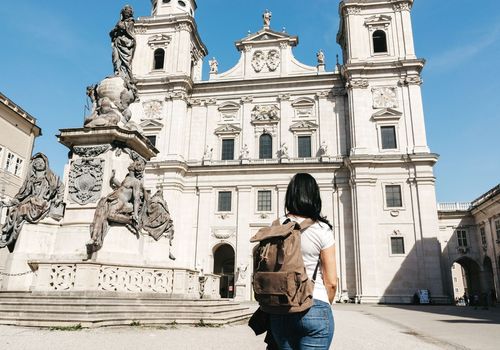 on WeGoTrip
History & Heritage Salzburg: a Scenic Walk from High Baroque to the Catacombs
Book on WeGoTripfrom€10
-
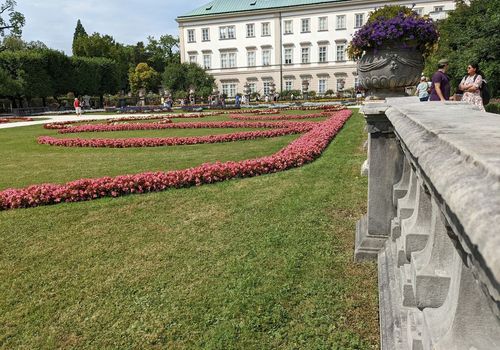 on WeGoTrip
Music activities Salzburg: Self-Guided Audio Walk Through Baroque Splendor
Book on WeGoTripfrom€10
Sold and delivered by WeGoTrip. You book on their site at their price; Viaqui may earn a commission, at no extra cost to you.
When to go
Getreidegasse is packed from late morning to mid afternoon, when the day coaches are in. Walk it before ten or after five. The town is at its fullest, and its dearest, during the festival in July and August. Hours of the museums are on our pages for Mozart's birthplace and the DomQuartier.
From here
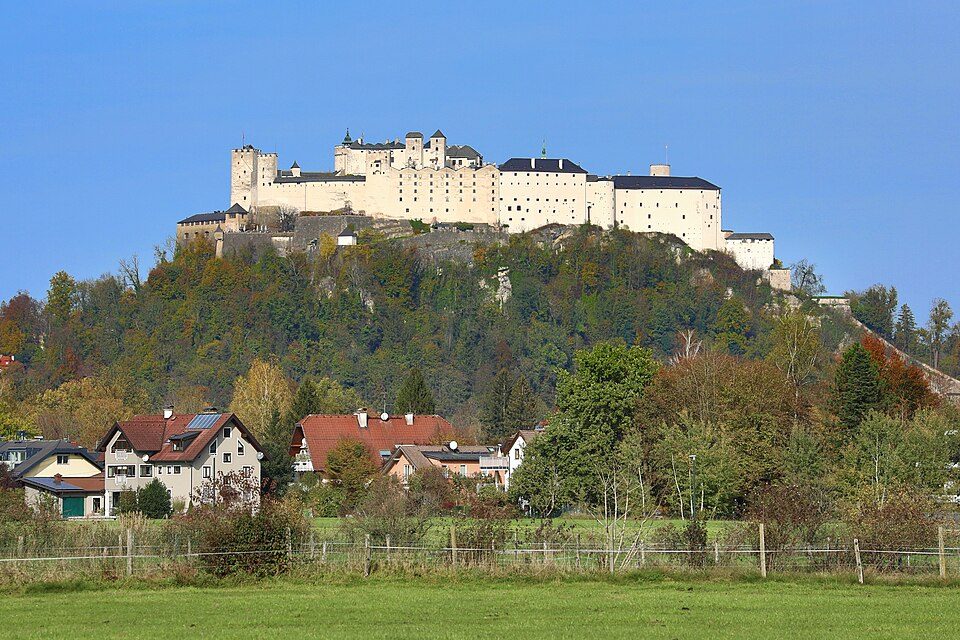
The Hohensalzburg Fortress, begun in 1077, is above you the whole way: a funicular climbs to it from the lane behind the cathedral, or you can walk up in about twenty minutes. Mozart's father Leopold and his widow Constanze lie in the cemetery of St Sebastian, across the river on Linzer Gasse, which is free and almost always empty. See what else there is in Salzburg, or open the attractions map of Austria.
Cover photo: Uoaei1, via Wikimedia Commons, CC BY-SA 4.0.
Frequently asked questions
Can you see Mozart's Salzburg on foot?
Yes. The old town is small and mostly closed to traffic. A route from the birthplace on Getreidegasse to the Mirabell gardens takes two to three hours without going inside, or half a day with one museum.
What is free to see in Salzburg old town?
Getreidegasse and its passages, Residenzplatz and the bells of its tower, Mozartplatz, St Peter's church and cemetery and the Mirabell gardens. The Mozart houses, the catacombs, the fortress and the DomQuartier need a ticket.
Mozart's birthplace or the Mozart Residence: which one?
The birthplace on Getreidegasse has the rooms where he was born and is the more crowded. The Residence across the river, where the family lived from 1773, is larger and quieter. A combined ticket covers both.
Is Mozart buried in Salzburg?
No. Mozart was buried in Vienna. In Salzburg his sister Nannerl lies in St Peter's cemetery, and his father Leopold and his widow Constanze in the cemetery of St Sebastian.
Do the audio walks of Salzburg include entry tickets?
No. The audio walks our partner sells are commentary with a map only. Entry to the Mozart houses, the fortress or the cathedral is bought separately.