

















Climbing the Leaning Tower of Pisa: who can go up, and how the timed ticket works
You can climb the Leaning Tower of Pisa, at a fixed time and with rules: who is not admitted, how the slot and the cloakroom work, what the ticket also covers, and whether the climb is worth it.

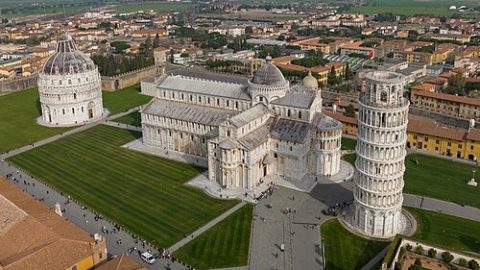
Work on the bell tower of Pisa Cathedral began in August 1173. Five years later, when the builders had reached the third storey, the ground on the south side started to give way: the tower stands on soft clay and sand, on foundations only about three metres deep. Then Pisa went to war, and the site lay idle for almost a century. That pause is thought to have saved the building, because it gave the soil time to settle under the weight.
When work resumed in 1272, the masons made the new storeys slightly taller on the low side to bring the line back, which is why the tower is faintly curved. The bell chamber was added in 1372, and the lean kept growing. On 7 January 1990 the tower was closed. Engineers hung some six hundred tonnes of lead on its high side, then drew out soil from beneath it, a little at a time, until the top had come back by about 45 centimetres. It reopened in December 2001, leaning roughly four degrees, and since then visitors have been allowed up again.
Can you climb it?
Yes. Visitors go up at fixed times, in groups, watched by staff, and the whole visit lasts about half an hour.
The staircase winds between the inner and the outer wall of the cylinder: about 250 steps, with no lift. The marble treads are worn into hollows, and because the tower tilts, the hollows move from one side of the step to the other as you turn. You feel yourself pushed against the outer wall, then the inner one. Near the top the stair comes out on an open gallery, and a last narrow flight leads to the bell chamber, where seven bells hang in the arches.

The top of the tower: the last open gallery and, set back above it, the bell chamber. Photo: FaceMePLS, via Wikimedia Commons, CC BY 2.0.

The bells in the arches of the top level. Photo: Luca Aless, via Wikimedia Commons, CC BY-SA 4.0.
Who is not admitted
- Children under eight. This is a rule of the tower, not advice, and there are no exceptions for children carried in arms.
- Anyone under eighteen without an adult.
- The climb is also a poor idea for anyone with a heart condition, vertigo or trouble with stairs. The steps are slippery when wet.
How the timed ticket works
- The slot is exact. Your ticket carries a time, and the places in each slot are limited. In season the good hours sell out days ahead.
- Late means lost. Be at the foot of the tower ten to fifteen minutes before. If you miss the group, the ticket is not moved to a later one.
- No bags, of any size. Handbags included. They go to the free cloakroom on the square before you line up, and it takes them only shortly before your slot. You go up with a phone or a camera in your hand.
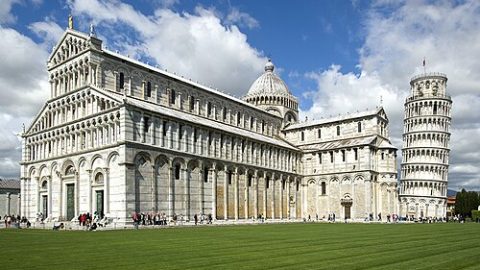
- The cathedral comes with it. A tower ticket also covers the cathedral next door, which has no fixed time: go in before or after, on the same day.
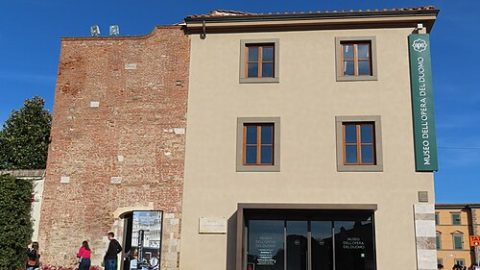
- The rest is separate. The Baptistery, the Camposanto and the two museums of the square are on their own tickets or combined ones, without a time slot.

The nave of the cathedral, which a tower ticket also opens. Photo: Eric Kilby, via Wikimedia Commons, CC BY-SA 2.0.
Is the climb worth it?
The square is free, and the tower from outside is the main sight: you do not need a ticket to see it lean. What the climb adds is the odd feeling of the tilt under your feet, and a view straight down onto the roof of the cathedral, then over the red roofs of the town to the hills.
The famous story belongs to the top, too: Galileo, born in Pisa, is said to have dropped two weights from here to show that they fall together. It comes from a biography written by his pupil long afterwards, and there is no record that it happened.
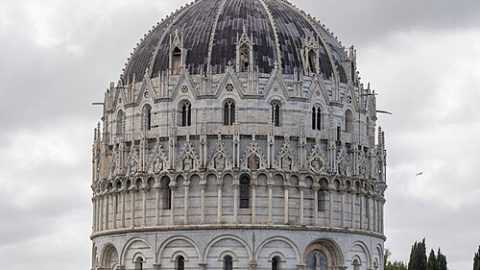
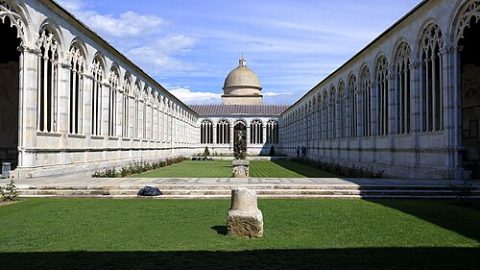
If you are travelling with small children, or the slots are gone, put the time into the Baptistery, the largest in Italy, whose dome has a long echo that the guards show off at intervals, and into the quiet cloister of the Camposanto.

Looking down from the tower: the edge of the square, and the roofs of Pisa. Photo: Zairon, via Wikimedia Commons, CC BY 4.0.
Reading the partner's listings
- A tower ticket, sold as general admission or as a fast track ticket for the tower and the cathedral, is a timed entry to the tower with entry to the cathedral. One of them has you collect the tickets at a desk on the square first, so arrive early.
- A listing called "Museum ticket and audio tour" names a museum in its title, while its list of inclusions mentions a ticket to the tower. Open it and read what is written before you pay.
- The "Leaning Tower Legends" audio tour is commentary only, with no entry.
- The audio walk through Pisa covers the city and the square from outside. No tickets are part of it.
These are the tickets and audio tours our partner sells in Pisa, with today's prices:
-
 on WeGoTrip
Pisa: Museum Ticket & City Audio Tour
Book on WeGoTripfrom5,099 kr
-
 on WeGoTrip
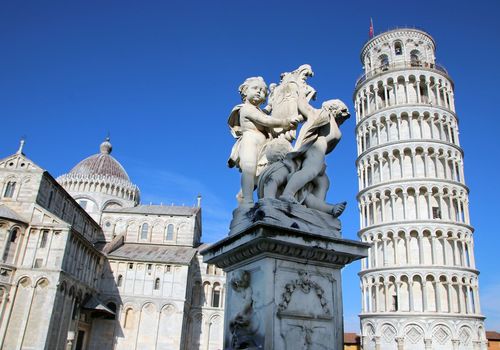
Pisa: Leaning Tower Legends Audio Tour
Book on WeGoTripfrom1,564 kr
-
 on WeGoTrip
Pisa: The Tower General Admission Ticket
Book on WeGoTripfrom4,250 kr
-
 on WeGoTrip
Leaning Tower of Pisa & Cathedral: Fast Track Ticket
Book on WeGoTripfrom4,757 kr
-
 on WeGoTrip
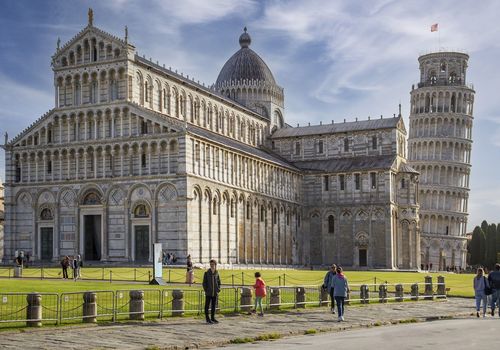
Pisa: an Audio Walk Through the City of Scholars, Squares, and Sacred Miracles
Book on WeGoTripfrom1,360 kr
-
 on WeGoTrip
History & Heritage Central Brussels: Discover the City’s Historic Quarter with an In-App Audio Tour
Book on WeGoTripfrom1,496 kr
Sold and delivered by WeGoTrip. You book on their site at their price; Viaqui may earn a commission, at no extra cost to you.
Getting there
From Florence a regional train reaches Pisa Centrale in about an hour. From that station the square is twenty-five minutes on foot, across the Arno and through the old town, or a short bus ride. Some trains also stop at Pisa San Rossore, a small station ten minutes' walk from the tower.
On a day trip, leave at least an hour between the arrival of your train and your slot. Hours and last entries change with the season: see our page for the Leaning Tower of Pisa.
From here
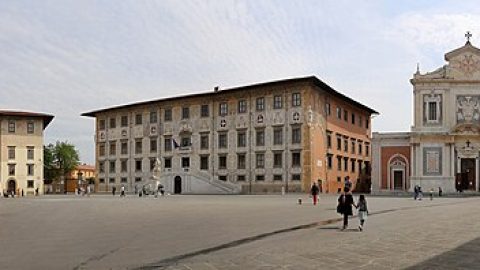
The cathedral, older than the tower by a century, is the building the tower was made to serve. Ten minutes away is Piazza dei Cavalieri, the square Vasari redesigned for the Medici, and beyond it the river, lined with painted palaces. Lucca, inside its ring of walls, is half an hour by train. See what else there is in Pisa, or open the attractions map of Italy.
Cover photo: PaestumPaestum, via Wikimedia Commons, CC BY 4.0.
Frequently asked questions
Can you climb the Leaning Tower of Pisa?
Yes. Visitors go up in groups at fixed times, with a ticket for an exact slot. The visit lasts about half an hour and there is no lift.
How many steps are there in the Leaning Tower of Pisa?
About 250, on a spiral staircase between the inner and outer walls. The marble is worn and the tilt makes the climb feel uneven.
Can children climb the Leaning Tower of Pisa?
Children under eight are not admitted, even carried. Anyone under eighteen has to go up with an adult.
Can you take a bag up the Leaning Tower of Pisa?
No. Bags of any size, handbags included, must be left in the free cloakroom on the square before your slot. You can carry a phone or a camera.
Does the tower ticket include Pisa Cathedral?
Yes, a tower ticket also covers the cathedral, which has no fixed time on the same day. The Baptistery, the Camposanto and the museums need their own or a combined ticket.