






Fisherman's Bastion and Castle Hill in Budapest: what is free, what needs a ticket, and how to get up
What you can see for nothing on Castle Hill in Budapest and what needs a ticket: Fisherman's Bastion, Matthias Church and the Royal Palace, with the ways up the hill and a route from the Vienna Gate to the palace terrace.

Fisherman's Bastion looks like the oldest thing on Castle Hill, and it is one of the newest. It was built between 1895 and 1902 by the architect Frigyes Schulek, who had just finished restoring the church beside it, as a terrace from which to look at the city. Its seven turrets stand for the seven Magyar chieftains who led their people into the country a thousand years earlier.
The name is older than the stones. In the Middle Ages this stretch of the town wall is said to have been defended by the guild of fishermen, who lived below it by the river. Schulek's bastion never defended anything. It was made for a view, and that leads to the question most visitors ask on the way up: how much of this hill do you have to pay for?
Fisherman's Bastion: free below, a ticket above
Most of it is free at all hours: the stairs that climb from the river side, the lower terraces, the arcades and the square behind, with the bronze statue of King Stephen on horseback.
A small ticket is asked only for the upper walkway and its turrets, and only during the day. Early in the morning and in the evening the barrier is open and nobody charges. The hours of the paid window change with the season.
The view from the free terraces is nearly the same as from the top level, which is a few metres higher. Part of the terrace is taken up by a café, where the price of the view is a drink.

What people climb for: the river and the Parliament from the bastion. Photo: Dguendel, via Wikimedia Commons, CC BY 4.0.
Matthias Church: a ticket, and a second one for the tower
Its official name is the Church of Our Lady. It is called after King Matthias Corvinus, who was married here in the fifteenth century and added to the building. When the Ottomans took Buda in 1541 it became the city's main mosque, and it stayed one for nearly a century and a half. In 1867 Franz Joseph and Elisabeth were crowned king and queen of Hungary in it, to a mass that Franz Liszt wrote for the day. The last Habsburg ruler, Charles IV, was crowned here in 1916.
What you see today is largely Schulek's work of the 1870s to 1890s: he rebuilt the church in a Gothic style and covered the roof with glazed tiles from the Zsolnay factory in Pécs. Inside, every wall and pillar is painted with patterns.
- The church needs a ticket. It is sold at an office across the square, not at the door.
- The bell tower is a separate ticket: a guided climb at set times, up nearly two hundred steps.
- Visits stop for services. On Sunday mornings and on days with weddings or concerts the hours are shorter.

The glazed tiles of the roof of Matthias Church. Photo: kallerna, via Wikimedia Commons, CC BY-SA 4.0.
The Royal Palace: free outside, museums inside
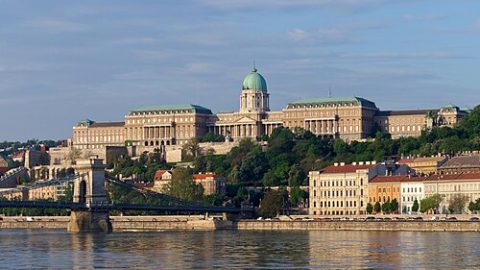
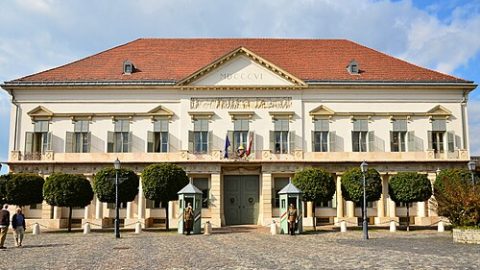
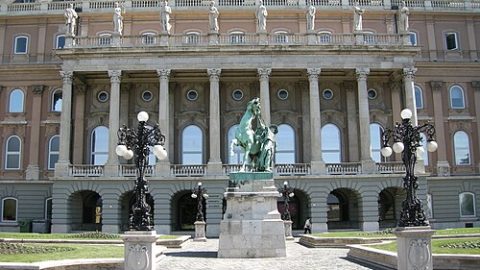
The southern end of the hill is the Royal Palace. It was shelled to ruins in the siege of Budapest in the winter of 1944 to 1945, and rebuilt afterwards in a plainer form with a new dome. It is not furnished as a palace. Its wings hold the Hungarian National Gallery, the Budapest History Museum and the national library, each with its own ticket.
The courtyards and terraces are free: the long terrace above the river, the statue of the mythical Turul bird, and the Matthias Fountain, which shows the king out hunting. For some years the whole district has been a building site, as parts destroyed in the war are put up again. Expect cranes and fences, and check which rooms and museums are open before you count on one.

The Royal Palace from the Pest side of the river. Photo: Paul Colin Hennig, via Wikimedia Commons, CC BY-SA 4.0.
Four ways up the hill
- The funicular. It has run since 1870 from Clark Ádám Square, at the Buda end of the Chain Bridge, to the gate of the palace. The ride lasts a minute or two, it needs its own ticket, and in season the queue is longer than the walk.
- The bus. Line 16 climbs from Deák Ferenc Square in Pest, over the Chain Bridge, to Dísz Square in the middle of the hill, on an ordinary public transport ticket.
- On foot. Paths and stairs lead up from Clark Ádám Square in ten to fifteen minutes. From the north, the streets rise gently from Széll Kálmán Square, on metro line M2, to the Vienna Gate.
- Escalators. At the Castle Garden Bazaar, on the river below the palace, escalators and a lift go up through the gardens.
Cars need a permit to enter the district, so do not plan on a taxi to the church door.

A carriage of the funicular, which first ran in 1870. Photo: Jakub Hałun, via Wikimedia Commons, CC BY-SA 4.0.
A route from north to south
The hill is a narrow plateau about a kilometre and a half long, with the old town at the northern end and the palace at the southern. Walked from the top end, the route runs downhill.
Start at the Vienna Gate. Follow the quiet streets of Baroque houses, Táncsics Mihály Street or Fortuna Street, to Holy Trinity Square, where the church and the bastion stand. Go on along Tárnok Street to Dísz Square, pass Sándor Palace, the office of the president, and come out on the terrace of the Royal Palace. Leave by the funicular, the paths or the Garden Bazaar. Without going inside anything it takes about two hours.
What our partner sells here
All of these are audio walks in the partner's app, on your own phone. None includes a ticket to the church, the turrets or a museum, so everything above still applies.
- The Castle Hill walk starts at the Vienna Gate and stays on the hill.
- The other walks begin in Pest, at the Basilica, at the Parliament or on Andrássy Avenue, and reach the hill at the end. They are longer city walks, of two to three and a half hours.
Choose by where the walk starts and how long it is, and bring earphones. These are the audio walks our partner sells for Castle Hill, with today's prices:
-
 on WeGoTrip
History & Heritage Budapest: Buda Castle Hill Walk Audio Tour
Book on WeGoTripfrom77 kr
-
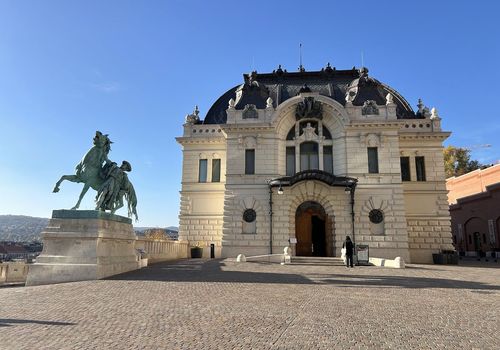 on WeGoTrip
Walking Tours Budapest: Self-Guided Audio Walk Through Buda Castle Heights
Book on WeGoTripfrom77 kr
-
 on WeGoTrip
Cultural Tours Budapest: Twin Cities Unveiled Audio Tour
Book on WeGoTripfrom111 kr
-
 on WeGoTrip
Sightseeing Tickets Budapest: Self-Guided Audio Walk Through Grand Boulevards and Buda
Book on WeGoTripfrom111 kr
-
 on WeGoTrip
Sightseeing Tickets Budapest: Self-Guided Audio Walk Through Danube and Castle Icons
Book on WeGoTripfrom111 kr
Sold and delivered by WeGoTrip. You book on their site at their price; Viaqui may earn a commission, at no extra cost to you.
When to go
The hill faces east over the river. In the morning you look into the sun, and the Parliament is a silhouette. From mid-afternoon the light falls on Pest, and after dark the bridges and the Parliament are lit. Tour groups fill the bastion from mid-morning to late afternoon. At sunrise it is empty, and the upper level is free. Current hours are on our page for Matthias Church.
From here
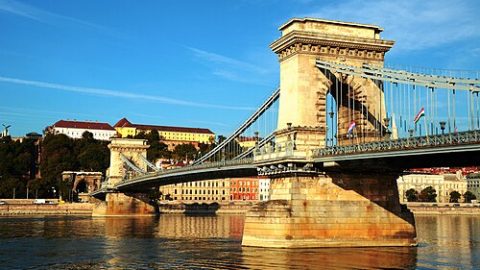
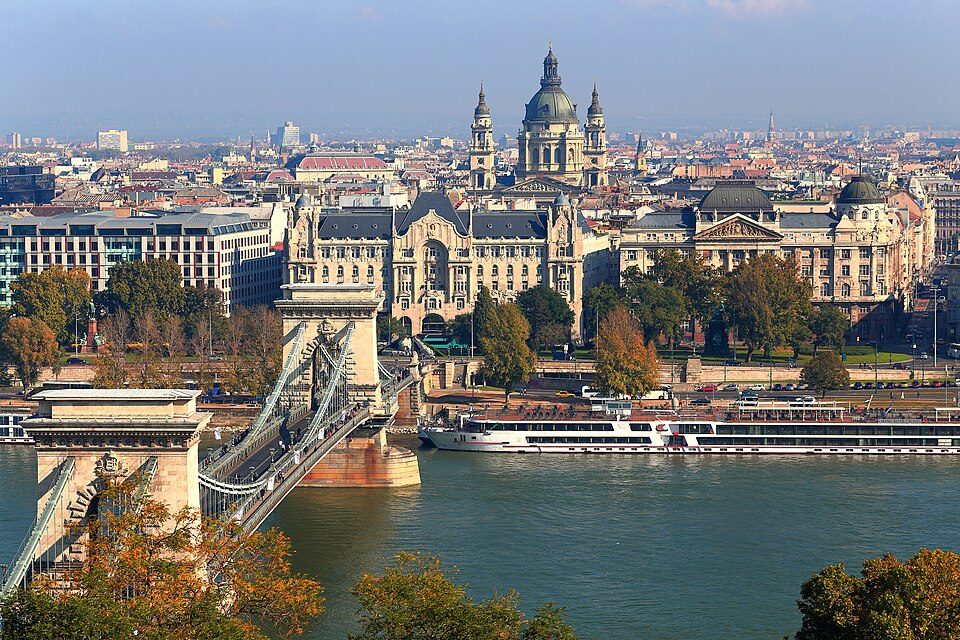
Go down to the Chain Bridge, the first permanent bridge between Buda and Pest, opened in 1849, and cross it on foot: the Basilica is ten minutes beyond. For the museums of the palace, see our page for Buda Castle. See what else there is in Budapest, or open the attractions map of Hungary.
Cover photo: Perituss, via Wikimedia Commons, CC0.
Frequently asked questions
Is Fisherman's Bastion free?
Most of it is: the stairs, the lower terraces and the arcades are free at all hours. Only the upper walkway and turrets need a small ticket, and only during the day. Early in the morning and in the evening they are open without charge.
Do you need a ticket for Buda Castle?
Not for the hill, the streets, the courtyards or the terraces of the Royal Palace. Tickets are needed for the museums inside the palace, for Matthias Church and for its tower.
How do you get up to Castle Hill in Budapest?
By the funicular from Clark Ádám Square, by bus 16 from Deák Ferenc Square, on foot in ten to fifteen minutes from the Chain Bridge, or by the escalators of the Castle Garden Bazaar. The funicular has its own ticket and often a queue.
Is Fisherman's Bastion old?
No. It was built between 1895 and 1902 by Frigyes Schulek as a viewing terrace. Its seven turrets stand for the seven Magyar chieftains.
When is the best time to visit Fisherman's Bastion?
At sunrise it is empty and the upper level is free. For photographs of the Parliament, come from mid-afternoon, when the light falls on Pest, or after dark.