




















Chambord or Chenonceau: which Loire château to choose, and how to reach them without a car
How Chambord and Chenonceau differ, which suits which traveller, how to reach each from Paris by train without a car, what the entry tickets cover, and where Villandry and Azay-le-Rideau fit.

King François I was twenty-five when he ordered a hunting lodge in the forest near Blois, in 1519. What rose there over the next decades has more than four hundred rooms and 282 fireplaces. In a reign of thirty-two years he slept in it for about seventy-two nights. Nobody knows for certain who designed it. Leonardo da Vinci, the king's guest at Amboise, died a few months before the first stone was laid, and the staircase at the centre of the plan has been linked with his name ever since.
Fifty kilometres to the south-west, at about the same time, a tax official named Thomas Bohier was building a house on the piers of an old mill in the river Cher. He was away at the wars, so his wife, Katherine Briçonnet, ran the works. Later a king's mistress added a bridge to it, and a queen put a gallery on the bridge. These are the two châteaux most visitors to the Loire want to see, and unless you have a car and a long day, you have to choose.
Chambord: the building is the visit
Chambord was made to impress from outside, and it does. Inside, the plan is a Greek cross of four great halls around the famous staircase: two spirals wound round the same hollow core, so that a person going up never meets a person coming down, though they glimpse each other through the openings.

The hollow core of the double staircase. Through the openings you see the people on the other flight. Photo: Thesupermat, via Wikimedia Commons, CC BY-SA 4.0.
The staircase leads to the roof terraces, which are the best part: a small town of chimneys, turrets and dormers, built so the court could watch the hunt come home. Around the château lies a walled park about the size of inner Paris.

The roof of Chambord, where the carving is: dormers, chimneys and turrets at arm’s length. Photo: Fab5669, via Wikimedia Commons, CC BY-SA 4.0.
The weak point is the rooms. The court travelled with its furniture, the place was never lived in for long, and much of it is bare. Come for architecture and space, and allow two to three hours.
Chenonceau: the house is the visit
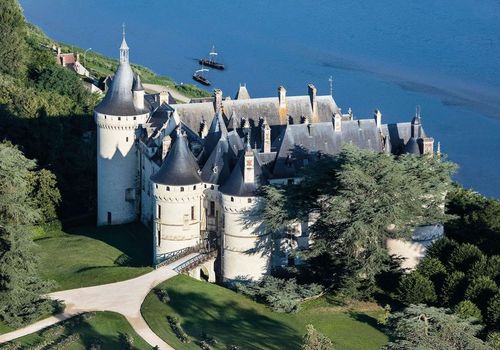
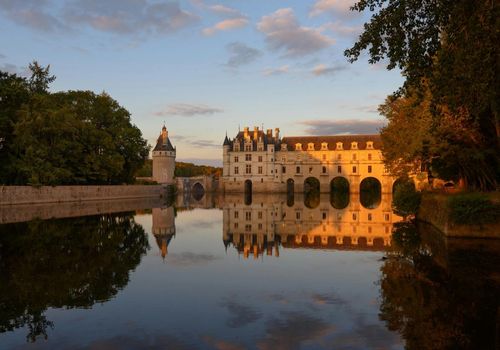
Chenonceau is small enough to take in and has been lived in for five centuries. Henri II gave it in 1547 to Diane de Poitiers, who built the bridge over the Cher. When he died in 1559 his widow, Catherine de' Medici, made Diane hand it over, and raised the two-storey gallery, sixty metres long, on top of the bridge. In the eighteenth century Louise Dupin, who held a salon here, was respected enough locally to bring it through the Revolution unharmed.

Chenonceau: the first house on the right, and the gallery that crosses the Cher. Photo: Gzen92, via Wikimedia Commons, CC BY-SA 4.0.
The gallery has a later story too. In the First World War it was a hospital ward. From 1940 to 1942 the Cher was the line between occupied France and the free zone: the front door of the château was on one side, and the door at the far end of the gallery opened onto the other.
The rooms are furnished and filled with flowers grown on the estate, the kitchens are down inside the piers of the bridge, and two formal gardens, one named for each of the rival women, flank the forecourt. It is also the busier of the two. Allow two hours.
Which one, then
- Choose Chambord if you care most about architecture, want the roof and the forest, or are travelling with children who need room to run.
- Choose Chenonceau if you want interiors, gardens and a story with people in it, or if you are coming by train with no wish to depend on a shuttle bus.
- Both in one day is realistic only by car or on an organised coach tour from Paris. By public transport, give each its own day, or sleep in Blois, Amboise or Tours.
Without a car
To Chenonceau
This is the easy one. A high-speed train from Paris Montparnasse reaches Saint-Pierre-des-Corps, the main-line station of Tours, in about an hour. From Tours a regional train runs to the village station of Chenonceaux in about half an hour, and the ticket office of the château is a five-minute walk from the platform. The regional trains are not frequent, so choose the return before you go.
To Chambord
Trains from Paris Austerlitz reach the station of Blois-Chambord in about an hour and a half. Despite the name, the château is some seventeen kilometres from Blois. From spring to autumn a shuttle bus links the station with Chambord a few times a day. Outside those months, or outside its timetable, the choice is a taxi. Check the shuttle's dates for the year before you count on it.
The tickets, and two more châteaux
The partner's listings for the Loire are plain entry tickets: no transport, no guide, and no list of inclusions beyond a description, so read it. Two points are worth knowing:
- Chambord is a state monument. Visitors under 18 and residents of the European Union under 26 enter free. The partner's ticket is sold in separate categories for residents of the European Economic Area and for others, and a tablet guide called the HistoPad is an optional extra.
- Chenonceau is privately owned. The state's free-entry rules do not apply, and it has its own reduced tickets for children and students.
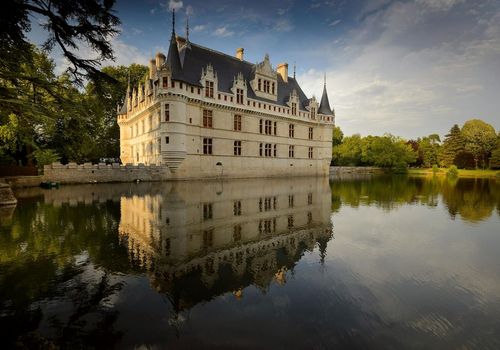
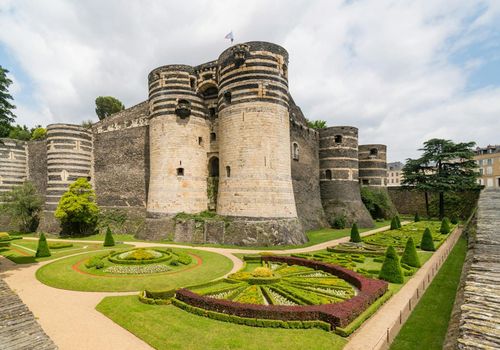
The same list holds two châteaux near Tours. Villandry is visited for its gardens, laid out again in Renaissance style from 1906 by Joachim Carvallo, with a kitchen garden planted like embroidery. Azay-le-Rideau, built between 1518 and 1527 on an island in the river Indre, is the small, perfect one, and it has a railway station of its own, about twenty minutes on foot from the gate. The fortress of Angers, further west, keeps the Apocalypse Tapestry, woven in the 1370s.

The gardens of Villandry, which are the reason to go there. Photo: Thérèse Gaigé, via Wikimedia Commons, CC BY-SA 4.0.
These are the château tickets our partner sells, with today's prices:
-
 on WeGoTrip
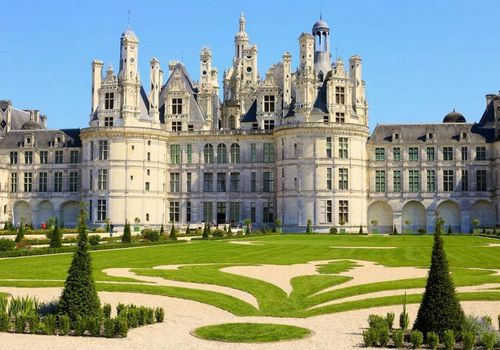
Château de Chambord: Entry Ticket
Book on WeGoTripfrom1,346 den
-
 on WeGoTrip
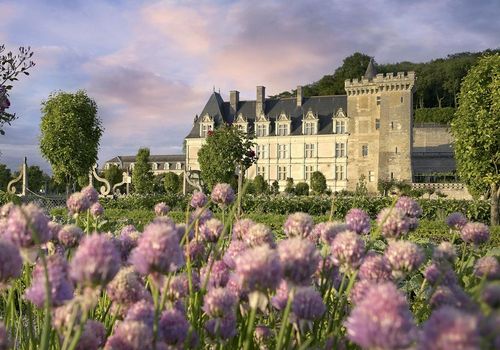
Château de Villandry: Entry Ticket
Book on WeGoTripfrom969 den
-
 on WeGoTrip
Château de Chenonceau: Entry Ticket
Book on WeGoTripfrom1,365 den
-
 on WeGoTrip
Château d'Azay-le-Rideau: Entry Ticket
Book on WeGoTripfrom898 den
-
 on WeGoTrip
Château d'Angers: Fast Track Ticket
Book on WeGoTripfrom751 den
-
 on WeGoTrip
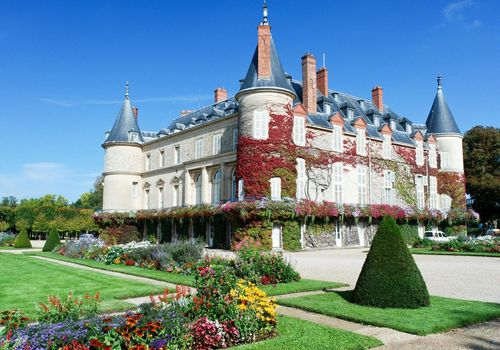
Château de Rambouillet: Entry Ticket
Book on WeGoTripfrom751 den
Sold and delivered by WeGoTrip. You book on their site at their price; Viaqui may earn a commission, at no extra cost to you.
Opening hours differ from one château to the next and by season: see our pages for the Château de Chambord and the Château de Chenonceau.
From here
If you came for Chambord, the royal château in the middle of Blois is five minutes on foot from the station and shows four centuries of building around one courtyard. If you came for Chenonceau, Amboise is one stop away: the royal château above the Loire, where Leonardo is buried, and the Clos Lucé, the house where he spent his last three years. To place the rest, open the attractions map of France.
Cover photo: Ввласенко, via Wikimedia Commons, CC BY-SA 3.0.
Frequently asked questions
Is Chambord or Chenonceau better?
They suit different visitors. Chambord is the larger and the more striking building, with its double staircase, roof terraces and forest, but its rooms are mostly bare. Chenonceau is smaller, furnished, set on a bridge over the river Cher, with gardens.
How do you get to Chenonceau from Paris by train?
Take a high-speed train from Paris Montparnasse to Saint-Pierre-des-Corps, about an hour, then a regional train from Tours to Chenonceaux, about half an hour. The château is a five-minute walk from the station.
How do you get to Chambord without a car?
Take a train from Paris Austerlitz to Blois-Chambord, about an hour and a half. From spring to autumn a shuttle bus runs from the station to the château, some seventeen kilometres away. At other times you need a taxi.
Can you visit Chambord and Chenonceau in one day?
By car or on an organised coach tour from Paris, yes. By public transport it is not realistic: give each château its own day, or stay overnight in Blois, Amboise or Tours.
How long do you need at Chambord?
Two to three hours for the château, the staircase and the roof terraces. Chenonceau takes about two hours with its gardens.