





Bruges in a day from Brussels: the belfry climb, the canals, and what is free
How to do Bruges as a day trip from Brussels: the train, a walking loop from the station through the Beguinage to the Markt, how the belfry climb works, what is free, what needs a ticket, and what the partner sells.

Around 1300 Bruges was one of the richest towns in northern Europe. English wool came in, Flemish cloth went out, and merchants from Venice, Genoa and the German ports kept houses here. All of it depended on the Zwin, a tidal inlet that let seagoing ships come within reach of the town. During the fifteenth century the Zwin silted up. The trade moved to Antwerp, and Bruges stopped growing.
For three hundred years almost nothing was built, because nobody had the money to pull the old town down. In 1892 the novel Bruges-la-Morte, by Georges Rodenbach, made its silent canals fashionable, and visitors have come ever since to see a medieval trading town that poverty kept whole. It is small enough for a day from Brussels. The question is how to spend that day, since the best of it is outdoors and free, and the lines form at a few doors.
The train from Brussels
Direct trains run all day from the three main stations of Brussels (Midi, Central and North) and take about an hour. There are no seat reservations: you buy a ticket and take any train. Leave by nine to be in Bruges before the coach groups.
The station is south of the old town. Most people walk straight up the main street to the Markt, which takes twenty minutes. A better way in is to turn right outside the station and enter through the park, which brings you to the quietest corner first.
A loop on foot
- Minnewater. A long pool that was once a harbour basin for barges, with a park along it. Ten minutes from the station.
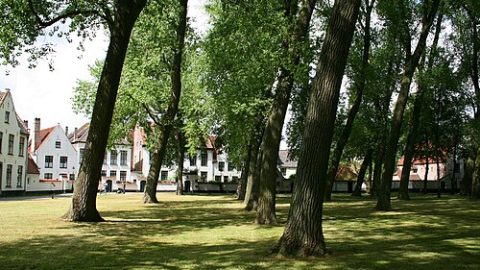
- The Beguinage. A walled court of white houses around a lawn with tall trees, founded in 1245 for beguines, lay women who lived as a religious community. Benedictine nuns have lived here since 1927. The court is free. You are asked to be quiet.
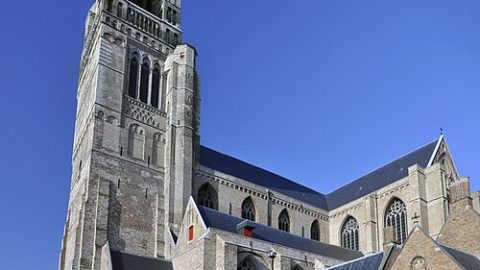
- The Church of Our Lady. Its brick tower, about 115 metres high, is one of the tallest in the world built of brick. Inside is the Madonna and Child that Michelangelo carved in about 1504 and two merchants of Bruges bought: the only sculpture of his to leave Italy while he was alive.
- Rozenhoedkaai. The bend of the canal where every photograph of Bruges is taken, with the belfry behind the gables.
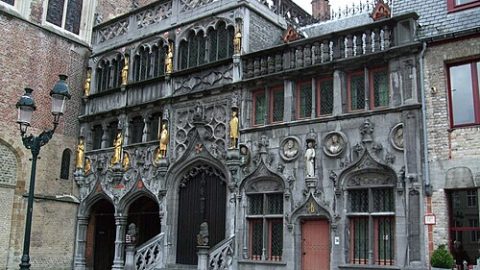
- The Burg. A small square with the Gothic City Hall of 1376 and, in the corner, the Basilica of the Holy Blood: a dark Romanesque chapel below, and above it the chapel that keeps a relic said to have been brought from the Holy Land in the twelfth century.
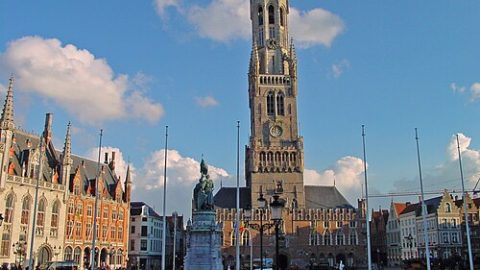
- The Markt. The market square, with the belfry on its south side.
Walked without stops, this takes an hour and a half. With stops it fills the day. The way back to the station from the Markt is the twenty-minute main street.

The Beguinage from the water side, with the swans that live on this bank. Photo: Zairon, via Wikimedia Commons, CC BY-SA 4.0.
The belfry climb
The belfry was the town's strongbox and alarm: its charters were kept here, and its bells ruled the working day. The tower burned in 1280 and was rebuilt. The eight-sided top was added in the 1480s. It once carried a wooden spire, which burned twice and after 1741 was not replaced. The tower is 83 metres high and leans slightly to the east.
There are 366 steps and no lift. The staircase narrows as it climbs, and near the top people going up and coming down share a stone spiral with a rope for a handrail. On the way you pass the old treasury, and the drum of the carillon, which has 47 bells. Only a limited number of visitors are allowed in the tower at one time, so tickets are sold for a time slot and the day's slots can run out by late morning in season. Book ahead, and choose a slot early in your day.
The partner does not sell the belfry. Tickets come from the city's museum service, online or on the spot.

The belfry from below. The eight-sided top stage was added in the 1480s. Photo: Ad Meskens, via Wikimedia Commons, CC BY-SA 3.0.

The gabled houses of the Markt, from the top of the belfry. Photo: Zairon, via Wikimedia Commons, CC BY-SA 4.0.
What is free, and what is not
- Free: the Markt and the Burg, the quays, Minnewater, the court of the Beguinage, the chapel of the Holy Blood, St Salvator's Cathedral, and the windmills on the grass rampart at the eastern edge of town.
- Part free: the Church of Our Lady. You can enter the nave without paying. The part with the Michelangelo and the tombs of Charles the Bold and Mary of Burgundy is a museum with a ticket.
- Ticket: the belfry, the Gothic Hall of the City Hall, the Groeningemuseum with its paintings by Jan van Eyck and Hans Memling, the treasury of the Holy Blood, and the canal boats.
The boats leave from five landing stages in the centre and make the same half-hour circuit. They are open, so they stop in bad weather, and in the cold months they run less or not at all. You pay at the landing stage.

Michelangelo's Madonna and Child, in its niche in the Church of Our Lady. Photo: Jean-Pol Grandmont, via Wikimedia Commons, CC BY 3.0.
What the partner sells in Bruges
- Audio walks through the old town, in the partner's app on your own phone. They follow routes close to the loop above, past the Beguinage, the Church of Our Lady, the Burg and the Markt. They are commentary only: the listings say plainly that entry tickets to the places on the way are not included. Bring earphones.
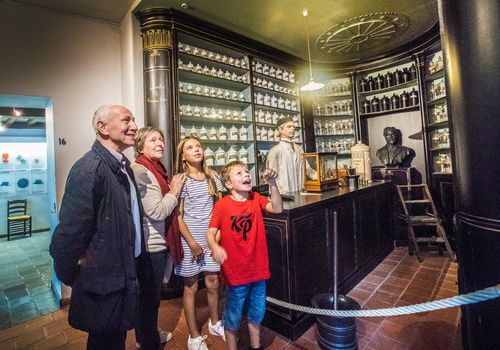
- An entry ticket to the Volkskundemuseum, the museum of folk life. It fills a row of seventeenth-century almshouses in the quiet Sint-Anna quarter, a quarter of an hour north-east of the Markt, with a schoolroom, a pharmacy, craftsmen's workshops and a small inn. It suits a second half of the day away from the crowd, and it is close to the windmills.
These are the walks and the ticket our partner sells in Bruges, with today's prices:
-
 on WeGoTrip
Museum & Attraction Tickets Volkskundemuseum: Entry Ticket
Book on WeGoTripfrom1,087 RSD
-
 on WeGoTrip
History & Heritage Brugge: Medieval Heartbeat Audio Tour
Book on WeGoTripfrom1,058 RSD
-
 on WeGoTrip
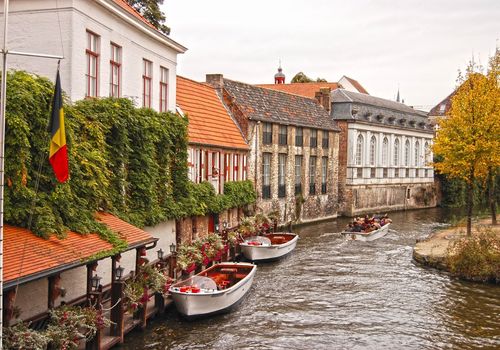
Sightseeing Tickets Bruges: Self-Guided Audio Walk Through Canals and Gothic Squares
Book on WeGoTripfrom1,175 RSD
-
 on WeGoTrip
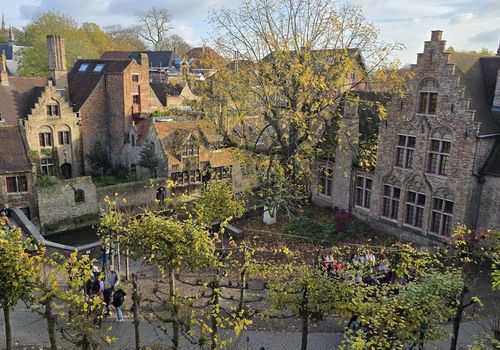
Sightseeing Tickets Bruges: Self-Guided Audio Walk Through Canals and Courtyards
Book on WeGoTripfrom1,175 RSD
-
 on WeGoTrip
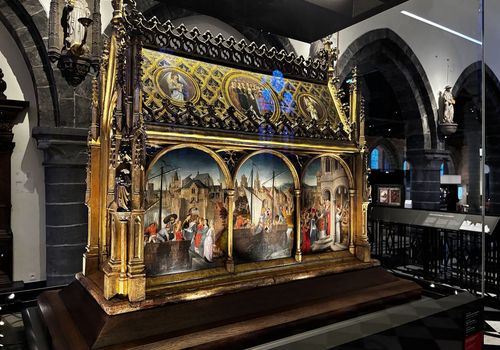
Sightseeing Tickets Bruges: Self-Guided Audio Walk Through Medieval Canals
Book on WeGoTripfrom1,175 RSD
Sold and delivered by WeGoTrip. You book on their site at their price; Viaqui may earn a commission, at no extra cost to you.

A room of the Volkskundemuseum: wash tubs, baskets and a wringer. Photo: Rainer Halama, via Wikimedia Commons, CC BY-SA 4.0.
Timing the day
Between eleven and four the Markt and the Rozenhoedkaai are full of groups. Use those hours for the edges: the Beguinage early, Sint-Anna and the windmills after lunch. Come back to the centre after five, when the day visitors leave and the canals are quiet again. Trains to Brussels run into the evening. Current hours for the tower are on our page for the Belfry of Bruges.
From here
Ghent is on the same railway line, halfway back to Brussels, and makes a second stop if you start early. The coast at Ostend is a quarter of an hour by train in the other direction. See our pages for the Church of Our Lady, the Basilica of the Holy Blood and the rest of Bruges, or open the trip planner for Belgium.
Cover photo: Ank Kumar, via Wikimedia Commons, CC BY-SA 4.0.
Frequently asked questions
How do you get from Brussels to Bruges?
By direct train from Brussels Midi, Central or North, in about an hour. There are no seat reservations. From the station in Bruges the Markt is a twenty-minute walk.
Is one day enough for Bruges?
Yes. The old town is small, and a loop from the station through the Beguinage, the Church of Our Lady, the Burg and the Markt takes an hour and a half without stops. A day leaves time for the belfry and one museum.
How many steps are there in the Belfry of Bruges?
There are 366 steps and no lift. The stairs narrow towards the top. Entry is by time slot because only a limited number of people may be in the tower at once.
What is free to see in Bruges?
The squares, the canalside quays, Minnewater, the court of the Beguinage, the chapel of the Holy Blood, St Salvator's Cathedral, the nave of the Church of Our Lady and the windmills on the eastern rampart.
Where is the Michelangelo in Bruges?
His Madonna and Child is in the Church of Our Lady, in the part of the church that is run as a museum and needs a ticket.