









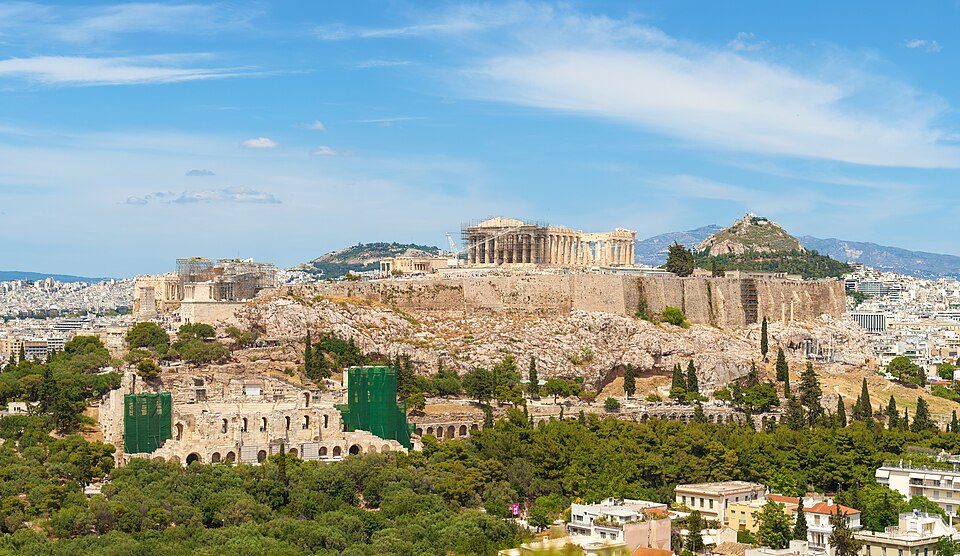














After the Acropolis: the Ancient Agora or the National Archaeological Museum?
With one afternoon left in Athens after the Acropolis, the choice is between the Ancient Agora at the foot of the rock and the National Archaeological Museum. What to see in each, how long to allow, and what the tickets cover.

In the months before the German army reached Athens in April 1941, the staff of the National Archaeological Museum emptied their own building. They dug trenches under the floors of the galleries, laid the marble statues in them and covered them with sand. The bronzes went into crates, the gold into the vaults of the Bank of Greece. When the occupiers arrived, they were shown bare rooms.
Everything came back up after the war, and it took years to put on show again. That collection is one of two things most visitors to Athens miss, because they have a morning on the Acropolis and an afternoon left. The other lies at the foot of the rock: the Ancient Agora, where the city did its daily business. If you have time for only one, this is how to choose.
The short answer
Choose the Agora if you want to stay outdoors, walk among ruins and see a Greek temple that still has its roof. It is ten minutes downhill from the Acropolis and takes an hour and a half. Choose the museum if you want the objects: the gold of Mycenae, the great bronzes pulled from the sea, the painted walls of Santorini. It is indoors, cool in summer, and needs two hours plus the trip to reach it.
With a full day, do the Acropolis first, the Agora straight after, and the museum in the afternoon or the next morning.
The Ancient Agora: what you are looking at
The agora was the open square of ancient Athens: market, law courts, council house, and the place where Socrates talked to whoever would stop. Until 1931 a whole neighbourhood stood on top of it. The American School of Classical Studies bought and took down several hundred houses to excavate, and its work here continues.
Three things deserve your time:
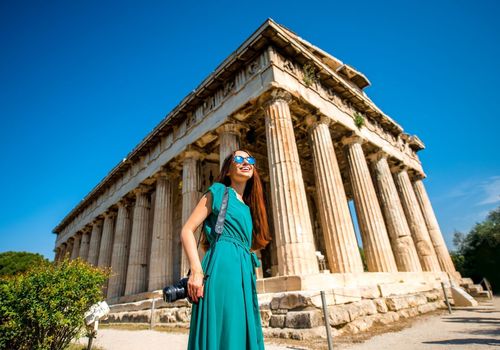
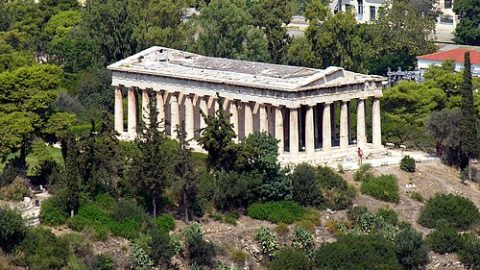
- The Temple of Hephaestus, on the low hill at the west side. Built in the second half of the 5th century BC, in the same decades as the Parthenon, it is the best preserved Doric temple in Greece. It survived because it was used as a church until 1834.
- The Stoa of Attalos, the long two-storey colonnade on the east side. The original was a gift from Attalos II, king of Pergamon, around 150 BC. What you see was rebuilt on the old foundations from 1953 to 1956.
- The museum inside the stoa, small and easy to underrate: the pottery shards on which Athenians scratched the name of the man they wanted exiled, a marble allotment machine used to pick jurors by lot, and a Spartan shield taken as a trophy in 425 BC.

The ground floor of the Stoa of Attalos, rebuilt in the 1950s. The site museum is behind the wall on the right. Photo: Erik Drost, via Wikimedia Commons, CC BY 2.0.
Between temple and stoa runs the Panathenaic Way, the road the great procession took up to the Acropolis. Beside it stands the small Byzantine church of the Holy Apostles, about a thousand years old. There is little shade away from the stoa and the temple hill, so carry water.

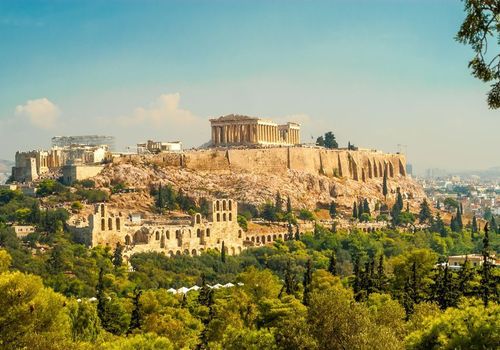
A path through the Agora, with the Acropolis above it. Photo: Zde, via Wikimedia Commons, CC BY-SA 4.0.
The National Archaeological Museum: what you are looking at
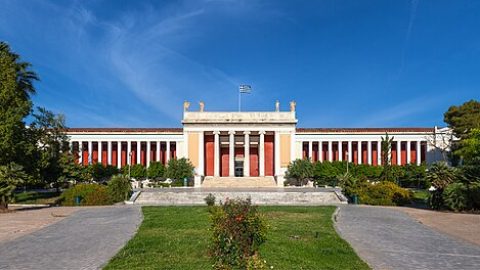
The museum is a long neoclassical building on Patission Street, finished in 1889, about two kilometres north of the Agora. The nearest metro stations are Omonia and Victoria, each around ten minutes away on foot. Do not try to see it all. These are the things that justify the journey:
- Mycenae, straight ahead from the entrance: the gold death masks that Heinrich Schliemann dug out of the shaft graves in 1876, including the one he named for Agamemnon. It is some three centuries older than any Trojan War could have been.
- The Artemision bronze: a bearded god over two metres tall, arm drawn back to throw, cast about 460 BC and found in the sea off Cape Artemision in the 1920s. Whether he held a thunderbolt (Zeus) or a trident (Poseidon) is still argued.
- The Jockey of Artemision: a small boy on a galloping horse, from the same wreck, made some three hundred years later.
- The Antikythera finds: a bronze youth and the corroded gearwheels of the Antikythera mechanism, a device for following the sun, the moon and the calendar, from a shipwreck found by sponge divers in 1900.
- The frescoes from Akrotiri, upstairs: two boys boxing, and a room of swallows and lilies, from the town on Santorini that a volcanic eruption buried in the Bronze Age.

The gold mask from Mycenae that Schliemann named for Agamemnon. Photo: Jebulon, via Wikimedia Commons, CC0.

The Artemision bronze in its hall: Zeus or Poseidon, about to throw. Photo: George E. Koronaios, via Wikimedia Commons, CC0.
What the tickets include
An Acropolis ticket does not open either place. Each has its own ticket and its own desk. What our partner sells falls into three kinds:
- A ticket with an audio tour: entry booked ahead, plus a commentary in the partner's app on your own phone, with a map from stop to stop. The one for the Agora lists entry to the site and to the museum in the stoa.
- An entrance ticket alone, for the Archaeological Museum. Read the options when you book: some of them name an audio guide, while the listing says the partner's own tour is not part of it.
- An audio tour without a ticket, for either place. It is the commentary only. You still buy your entry, ahead or at the gate.
Bring earphones for any of them, and download the tour before you leave the hotel. One caution: a title and its contents can differ, so read the list of what is included and check that the entry named is for the place you mean. The Acropolis Museum, the modern building below the south side of the rock, is a third place, with a ticket of its own.
These are the tickets and audio tours our partner sells for the Agora and the Archaeological Museum, with today's prices:
-
 on WeGoTrip
Archeology Athens: National Archaeological Museum Ticket & Audio Tour
Book on WeGoTripfrom13,326 Ft
-
 on WeGoTrip
Art & Museums National Archaeological Museum Entrance Ticket
Book on WeGoTripfrom11,153 Ft
-
 on WeGoTrip
History & Heritage Athens: National Archaeological Museum Audio Tour
Book on WeGoTripfrom4,037 Ft
-
 on WeGoTrip
History & Heritage Athens: Ancient Agora Stories Audio Tour
Book on WeGoTripfrom4,771 Ft
-
 on WeGoTrip
Skip The Line Tickets Athens: Ancient Agora Ticket & Audio Tour of Antiquity
Book on WeGoTripfrom3,670 Ft
Sold and delivered by WeGoTrip. You book on their site at their price; Viaqui may earn a commission, at no extra cost to you.
When to go, and in what order
The Agora is an open site and closes earlier in winter than in summer. In the hot months only the first hours of the morning and the last of the afternoon are comfortable. The usual order works: the Acropolis at opening time, then down the north-west side of the rock to the Agora, then lunch. Keep the museum for the heat of the afternoon.
State sites and museums in Greece have long been free on a few fixed days of the year and on the first Sunday of the winter months, which fills them. Hours for both places change with the season: the current ones are on our pages for the Ancient Agora and the National Archaeological Museum.
From here
From the Agora's gate on Adrianou Street you are five minutes from Monastiraki Square and the lanes of Plaka. The Roman Agora, with the Tower of the Winds, is a short walk east. From the museum, the metro at Omonia takes you back to the centre in two stops. For the rest of Athens, or to fit it into a longer trip, open the trip planner for Greece.
Cover photo: Jakub Hałun, via Wikimedia Commons, CC BY 4.0.
Frequently asked questions
Does the Acropolis ticket include the Ancient Agora?
No. The Ancient Agora has its own ticket, which also covers the small museum inside the Stoa of Attalos. The National Archaeological Museum is ticketed separately too.
How long do you need at the Ancient Agora?
About an hour and a half: the Temple of Hephaestus, the Stoa of Attalos with its museum, and the walk between them along the Panathenaic Way.
How long do you need at the National Archaeological Museum in Athens?
Two hours are enough for the Mycenaean gold, the Artemision bronzes, the Antikythera finds and the frescoes from Akrotiri. Add the trip: the museum is about two kilometres north of the Acropolis area.
Where is the Mask of Agamemnon?
In the National Archaeological Museum in Athens, in the Mycenaean hall straight ahead from the entrance. It was found at Mycenae in 1876.
Is the Acropolis Museum the same as the National Archaeological Museum?
No. The Acropolis Museum is the modern building below the south side of the rock and shows what was found on the Acropolis. The National Archaeological Museum is a separate, older museum two kilometres to the north, with finds from all of Greece.