









Seeing Michelangelo's David without the queue: how the Accademia in Florence works
How to see Michelangelo's David at the Galleria dell'Accademia in Florence without losing a morning: the two lines, how a reserved slot works, what else is inside, and what the partner's tickets include.

The block of marble had been lying in the yard of Florence Cathedral for nearly forty years. Two sculptors had started on it and given up. It was very tall, awkwardly shallow, and the stone was not of the best. In the summer of 1501 the cathedral's works office handed it to Michelangelo, who was twenty-six, and he finished the figure early in 1504.
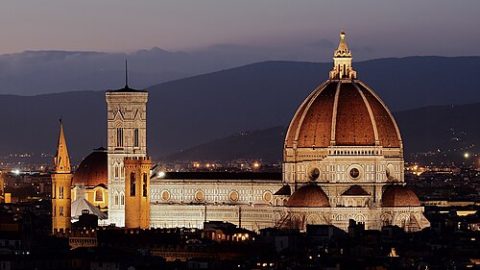
The statue had been ordered for a buttress high on the cathedral. Once people saw it, a committee that included Leonardo da Vinci and Botticelli met to decide on a better place, and the David was set up beside the door of the town hall, in the open air. It stood there for 369 years. In 1873 it was rolled through the streets on rails, inside a wooden frame, to the Accademia, and the domed room built to receive it opened in 1882. Nearly everyone who enters this museum comes for that one figure, which is why the difficulty of the visit is on the pavement outside.
Why the line is so long
The Accademia is a small museum on a narrow street, Via Ricasoli, with no forecourt and a limit on how many people may be inside at once. So the waiting happens on the pavement, in two lines:
- one for visitors with a reservation, grouped by time slot;
- one for visitors without, who are let in only as space allows. In the warm months that can mean hours, in the sun.
Everybody passes a security check at the door.
How a reserved slot works
A reservation is for a short entry window at a fixed time. In most cases what you receive is a voucher, which has to be exchanged for a paper ticket before you join the line: at a ticket desk near the entrance, or at a meeting point named by the seller. Allow fifteen to twenty minutes for that.
"Skip the line" here means the reserved line instead of the other one. It is shorter, not absent, and it moves at the speed of the security check.
The museum is closed on Mondays. The first slots of the morning and the last hour and a half of the day are the quietest. On the first Sunday of the month entry is free, and the pavement is at its worst.
What you see, in order
The whole museum takes forty-five minutes to an hour, and the rooms prepare you for the statue if you let them.
The Hall of the Colossus
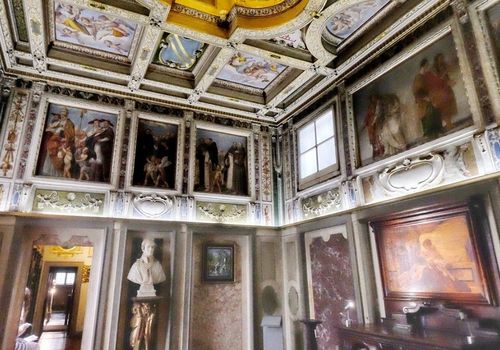
In the middle of the first room stands Giambologna's full-size plaster model for the Abduction of a Sabine Woman. The marble made from it is in the Loggia dei Lanzi, in Piazza della Signoria. Around the walls are Florentine paintings of the years when Michelangelo was a boy.

The first hall, with Giambologna's plaster model in the middle. Photo: Francesco Bini, via Wikimedia Commons, CC BY-SA 4.0.
The Hall of the Prisoners
A long gallery leads to the David, lined with four unfinished figures that Michelangelo began for the tomb of Pope Julius II, and with his St Matthew. Each seems to be pulling itself out of the block. Go slowly here: the chisel marks show how he worked, from the front of the stone inwards.

One of the unfinished Prisoners, with the David at the end of the hall. Photo: Petra 99MI, via Wikimedia Commons, CC BY-SA 4.0.
The Tribune
The David stands under a skylight, a little over five metres high with its base. Walk all the way round. From behind you see the sling lying across the shoulder and the tree stump that braces the right leg. The head and the right hand are large for the body, perhaps because the figure was planned to be seen from far below.
It has been hurt twice. In 1527, during a riot, a bench thrown from a window of the town hall broke the left arm into three pieces. In 1991 a man struck the toes of the left foot with a hammer. That is why there is a barrier.
What most people skip
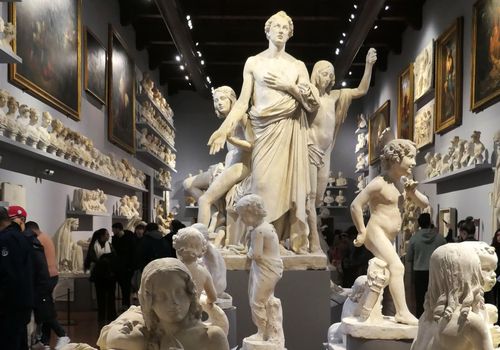
Beyond the Tribune a long hall is filled with the white plaster casts of the nineteenth-century sculptor Lorenzo Bartolini. A side wing holds the Medici collection of musical instruments, with pieces by Stradivari and by Bartolomeo Cristofori, who invented the piano in Florence. Upstairs are paintings on gold ground.

The hall of plaster casts, beyond the David, where most visitors do not go. Photo: Andy Montgomery, via Wikimedia Commons, CC BY-SA 2.0.
What the partner's listings include
- A priority entry ticket with an audio tour and a city walk includes entry, commentary for the gallery in the partner's app, and a walk through the centre afterwards. The voucher is exchanged for a paper ticket at a meeting point.
- A gallery ticket with a sightseeing audio tour includes entry and an audio walk through the city. Read the exclusions: on this one the commentary does not cover the inside of the gallery.
- An audio tour "without a ticket" is commentary only. You book your entry yourself.
- A combined Accademia and Uffizi ticket covers both museums, with an audio tour.
- The other listings are audio walks on the theme of Michelangelo. They pass the door, they do not go in.
These are the Accademia tickets and audio tours our partner sells, with today's prices:
-
 on WeGoTrip
Art & Museums Florence: Accademia Priority Entry Ticket and Audio Tour with a City Walk
Book on WeGoTripfrom112.46 KM
-
 on WeGoTrip
History & Heritage Florence: Accademia Gallery Ticket & Sightseeing Audio Tour
Book on WeGoTripfrom105.61 KM
-
 on WeGoTrip
Art & Museums Florence: Accademia Audio Tour with a City Walk (Without a Ticket)
Book on WeGoTripfrom36.18 KM
-
 on WeGoTrip
History & Heritage Florence: Accademia & Uffizi Ticket and Audio Tour
Book on WeGoTripfrom164.29 KM
-
 on WeGoTrip
Walking Tours Florence: Self-Guided Audio Walk Through Renaissance Splendor
Book on WeGoTripfrom13.69 KM
-
 on WeGoTrip
Walking Tours Florence: Walk Through the World of Michelangelo
Book on WeGoTripfrom13.69 KM
Sold and delivered by WeGoTrip. You book on their site at their price; Viaqui may earn a commission, at no extra cost to you.
If the slots are gone: the two copies
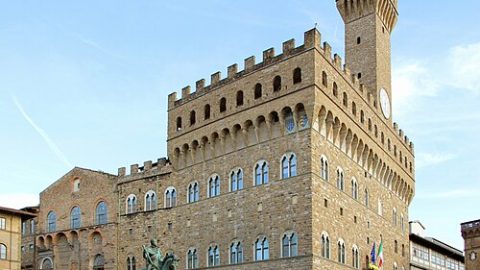
Florence has two full-size copies outdoors, both free. The marble one has stood since 1910 on the spot the original occupied, at the door of Palazzo Vecchio. A bronze one looks over the city from Piazzale Michelangelo, on the hill across the river.
They give you the size and the setting. They do not give you the surface, and the copy in the square is seen against a busy wall instead of an empty niche. If the David is the reason you came to Florence, book the original.

The copy at the door of Palazzo Vecchio, where the original stood until 1873. Photo: Peter K Burian, via Wikimedia Commons, CC BY-SA 4.0.
Hours change through the year: see our page for the Galleria dell'Accademia.
From here
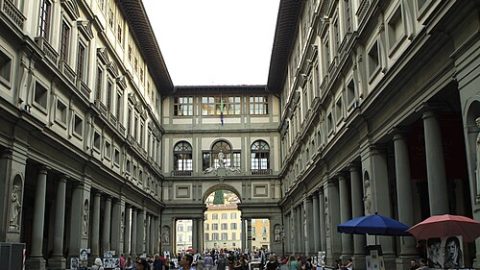
The convent of San Marco, with the frescoes Fra Angelico painted in the monks' cells, is two minutes north. The cathedral is five minutes south, straight down Via Ricasoli. The Medici Chapels, with more Michelangelo, are ten minutes west, and the Uffizi a quarter of an hour away. See what else there is in Florence, or open the attractions map of Italy.
Cover photo: Jörg Bittner Unna, via Wikimedia Commons, CC BY 4.0.
Frequently asked questions
How can you see Michelangelo's David without queuing?
Reserve a time slot in advance. You then use the reserved line, which is much shorter than the line for visitors without a booking, though everyone still passes the security check.
Do you need to book the Accademia in advance?
It is not compulsory, but without a reservation you wait in a separate line that is admitted only as space allows, which can take hours in season. Popular slots sell out days ahead.
Is the David in Piazza della Signoria the real one?
No. It is a marble copy placed there in 1910, on the spot where the original stood from 1504 to 1873. The original is in the Galleria dell'Accademia.
How long does a visit to the Accademia take?
Forty-five minutes to an hour for the whole museum. Add fifteen to twenty minutes before your slot if your voucher has to be exchanged for a ticket.
What else is in the Accademia besides the David?
Michelangelo's four unfinished Prisoners and his St Matthew, Giambologna's plaster model for the Sabine group, a hall of nineteenth-century plaster casts, Florentine paintings and a collection of historic musical instruments.